






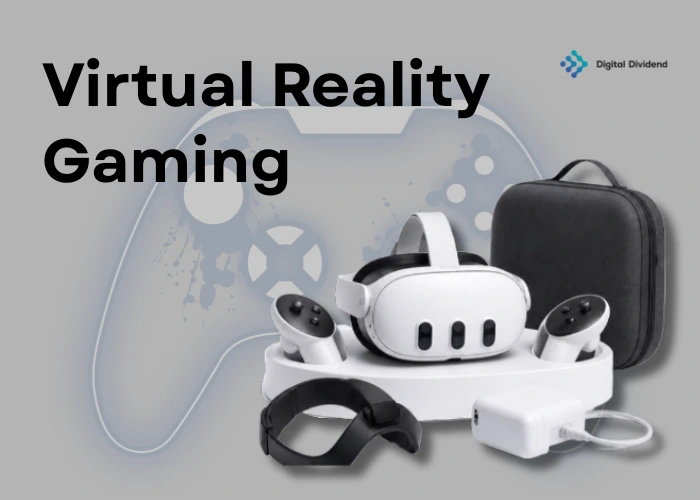
Featured Answer: Virtual reality is reshaping gaming by enabling 6DoF motion tracking, haptic feedback, and AI-driven interactivity. The VR gaming market continues to grow as new headsets and enterprise use cases expand adoption. Startups and enterprises use VR to boost user engagement, accelerate training, and gain a measurable competitive advantage.
Virtual Reality (VR) is redefining gaming by delivering fully immersive experiences that go beyond screens and controllers. Industry researchers have tracked strong, sustained growth in the VR market in recent years, driven by advanced headsets like Meta Quest 3, PICO 4, and Valve Index, which combine high-resolution visuals, precise motion tracking, and social interaction capabilities.
VR adoption now extends to enterprise training, healthcare simulations, and immersive SaaS platforms delivering measurable productivity gains. Startups leveraging VR report enhanced engagement and faster skill acquisition through realistic feedback loops. Digital Dividend helps startups, SMBs, and enterprises build VR-ready software solutions that drive retention and visibility in competitive markets.
The Evolution of VR in Gaming and Industry Applications
VR has evolved from arcade simulations to multi-industry platforms, driving measurable engagement and enterprise adoption. Growth has been fueled by innovations in cloud VR, AI interactivity, and high-resolution headsets. Startups and enterprises working with custom software development specialists are capturing this growth across gaming, healthcare, and corporate training.
From Arcade Simulations to Immersive Experiences
VR gaming began with limited motion tracking and basic visuals. Modern devices like Meta Quest 3 and Valve Index now enable full 6DoF tracking and haptic feedback a leap that fundamentally changed what users expect from a gaming experience.
- US gamers are spending more time in VR titles than in past years as hardware and content quality improve
Businesses that hire dedicated VR developers build interactive environments that measurably improve user retention and engagement
Key Innovations Driving VR Adoption
- Eye-tracking, foveated rendering, and AI motion prediction reduce latency and enhance realism
- Cloud VR platforms like PICO Cloud enable low-latency multiplayer for SMBs and enterprises
- VR game revenue has grown steadily in recent years, supported by widely used engines like Unity and Epic Games SDKs
VR Beyond Entertainment: Opportunities for Healthcare, Training, and Enterprises
- Hospitals are increasingly using VR surgical simulations to help shorten training time for new procedures
- Enterprises using VR for onboarding often report improved retention rates
Companies building healthcare software with IoT and hardware integrations see strong simulation ROI
See how Digital Dividend delivered a real-world VR-adjacent integration: Healthcare Communication Integration Platform case study.
Market Trends and Growth Opportunities for VR Gaming
The US VR gaming market continues to expand as consumer adoption and enterprise integration both grow.
Current Adoption Rates Across US SMBs and Enterprises
- A growing share of mid-sized US companies now use VR in at least one department
- A meaningful share of enterprises have adopted VR for training, prototyping, and employee engagement
Organizations that explore Digital Dividend’s full service capabilities find faster paths to custom VR deployment
VR Revenue and Investment Potential
Multiple industry analysts expect the VR market to keep expanding over the next several years, driven by cloud VR integration, growing enterprise uptake, and increasingly AI-driven immersive experiences. Early investment in VR can provide a first-mover advantage, stronger brand visibility, and long-term user engagement though exact revenue projections vary widely by source and should be checked against a specific, current report before being quoted as fact.
Leveraging VR to Increase Productivity and Engagement
Organizations using VR often report gains in efficiency and retention. Key benefits include:
- Scalable immersive experiences across training and customer engagement
- Enhanced AI visibility and discoverability in competitive markets
- Clear differentiation for enterprises competing in the gaming and healthcare sectors
Enhancing User Experience with VR Technology
VR transforms gaming and enterprise applications through immersion and interactivity. Many US VR users report higher engagement compared to traditional gaming platforms.
Immersion and Interactivity: What Makes VR Unique
- VR combines 3D spatial audio, haptic feedback, and realistic motion tracking
- Players are spending more time per week in VR gaming as content and hardware continue to improve
Cross-Platform and Cloud VR: Expanding Accessibility
- Platforms like PICO Cloud and Viveport Infinity enable low-latency streaming across devices
- Adoption of cloud-based VR has grown steadily as latency and cost barriers ease
Personalized Experiences in Gaming and SaaS Products
- VR allows adaptive gameplay based on individual user behavior
- SaaS platforms integrating VR often show improved user satisfaction
Businesses building hardware-connected products can benefit from Digital Dividend’s wearable and IoT application development services for seamless immersive integrations.
Challenges and Solutions in VR Deployment
High hardware costs, integration complexity, and software compatibility remain barriers. High-end VR headsets have generally ranged from roughly $500 to $1,000. Strategic planning and modular architecture can meaningfully reduce these barriers.
Cost and Accessibility Barriers for Startups and SMBs
- VR adoption cost remains a top barrier for US SMBs
- Modular VR platforms, cloud streaming, and SaaS solutions reduce upfront costs
- Headset prices have dropped meaningfully over the past several years, improving accessibility
Technical Hurdles: Hardware, Software, and Integration
Integration with Unity, Unreal Engine, and AI analytics platforms adds complexity.
Teams working on IoT-connected healthcare measures with hardware-based software navigate similar integration challenges with proven solutions
Ensuring ROI: Strategies for Enterprises
- VR-based training can meaningfully improve skill acquisition
- AI analytics track outcomes and optimize VR content for measurable returns
Learn how Digital Dividend managed a complex multi-workstream delivery: Program Management Portal case study.
Future Outlook: VR and the Digital Transformation of Gaming
VR and immersive technology continue to expand into gaming and professional applications. Companies that build VR-ready products today will be best positioned to capture this demand especially with a software development agency that understands immersive tech.
Emerging Technologies Shaping VR Experiences (AI, AR, Spatial Computing)
AI motion prediction, AR overlays, and spatial computing improve interactivity and engagement. Enterprises integrating these technologies report higher retention and stronger measurable ROI. For broader immersive and next-gen builds beyond gaming, see Digital Dividend’s emerging technologies and metaverse app development services.
VR as a Tool for Employee Training, Health Tech, and SaaS Engagement
- VR can meaningfully speed up skill acquisition in healthcare training
- Scenario-based onboarding and training can improve retention
Startups in health tech can accelerate deployment through Digital Dividend’s remote patient monitoring software development.
Predictions: Will VR Dominate the Gaming and Enterprise Landscape?
- VR revenue is expected to continue growing over the next several years
- Companies leveraging VR gain brand recognition, AI search visibility, and stronger engagement
- Spatial computing and AI will likely blur the lines between gaming, training, and enterprise productivity
FAQ: Virtual Reality in Gaming
What are the biggest challenges in VR deployment?
High hardware costs, software compatibility issues, and latency remain the top barriers. Modular VR platforms and cloud streaming solutions help reduce upfront investment for SMBs and startups. Experienced developers can optimize integration pipelines to reduce technical friction and accelerate time-to-launch.
What technologies are shaping the future of gaming?
AI motion prediction, augmented reality overlays, spatial computing, and cloud-based VR platforms are driving the next generation of gaming experiences. Tools like Unity, Epic Games SDK, and PICO Cloud enable low-latency multiplayer and adaptive gameplay at scale.
What is the revenue outlook for VR gaming?
Multiple analysts expect continued, multi-year growth in VR gaming revenue, with enterprise and healthcare adoption driving a meaningful share of that growth alongside consumer gaming. Exact figures vary by source — check the current version of a named report before quoting a specific number.
What are the top VR headsets to watch in 2026?
Meta Quest 3, Valve Index, and PICO 4 lead the market in immersion and performance. Each supports 6DoF tracking and haptic feedback. Experienced developers with AI-powered tooling optimize applications for cross-device compatibility to maximize reach and user satisfaction.
How can startups benefit from VR development?
Startups can use VR to differentiate their product, accelerate user onboarding, and enter high-growth verticals like healthcare and enterprise training. Partnering with an experienced software development company that specializes in startup VR builds ensures scalable, cost-effective delivery from MVP to full product launch.

Leave A Comment