

dd-logo-loader
logo
logo

Language

Awesome Image Awesome Image

AI Virtual Assistant Development Services

Choosing the wrong AI solution can cost you six months of development time and significantly exceed your budget before a single user interaction takes place. Digital Dividend has spent 15 years and 300+ projects helping startups, SMEs, and enterprises build software that actually performs. Our AI virtual assistant development services give your business a reliable, scalable way to automate conversations, support customers, and free your team to focus on higher-value work.
Whether you need a text-based chatbot for your website, a voice agent for outbound calls, or a multi-agent system embedded in your enterprise infrastructure, we design and build it around your specific goals.
Not sure where to start?
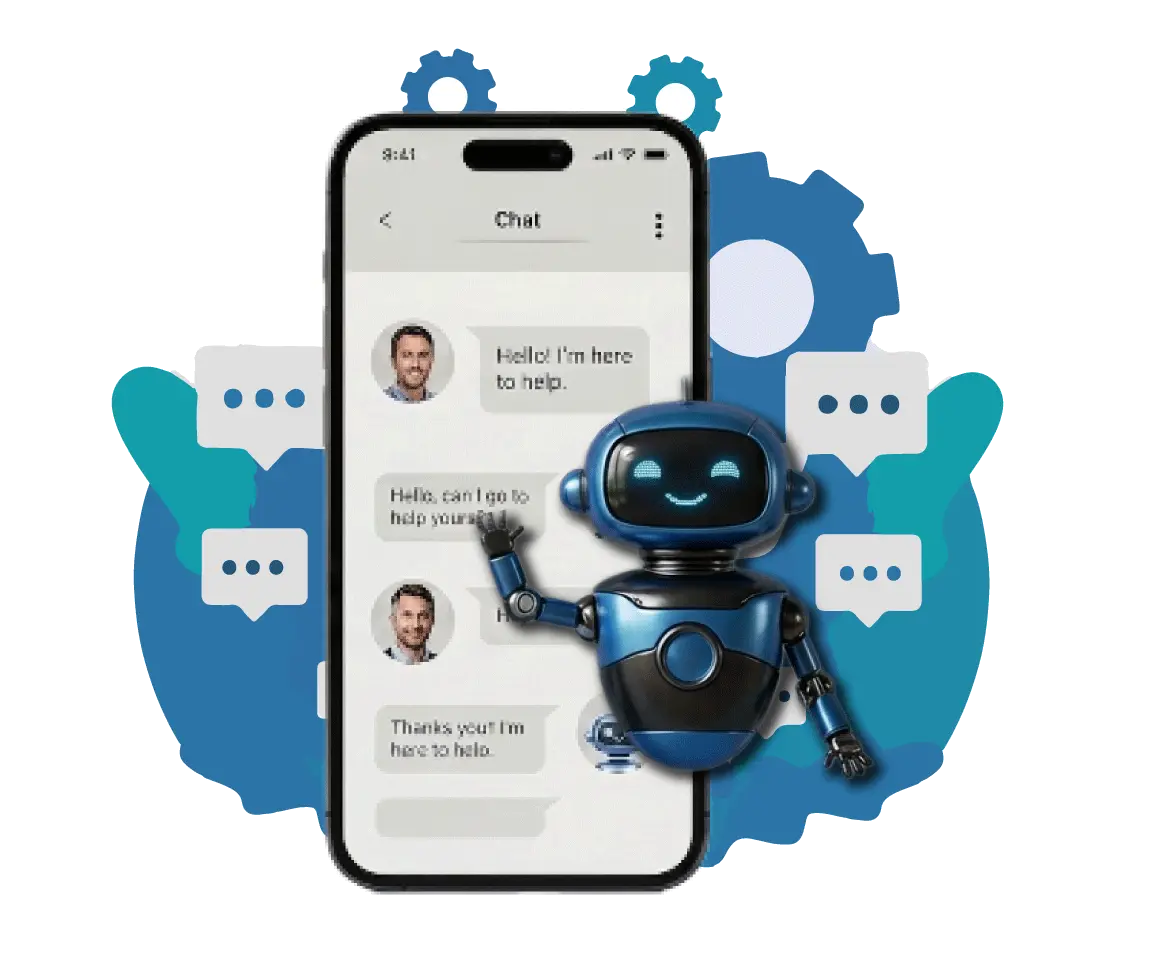
Digital Dividend's specialized AI virtual assistant development services, featuring a smartphone displaying an automated customer service chat interface next to a friendly blue robot assistant graphic.

What is an AI virtual assistant?

An AI virtual assistant is software that uses natural language processing and machine learning to understand user queries, automate tasks, and respond across voice, text, and chat channels. Businesses deploy custom AI assistants to handle customer support, manage scheduling, and streamline operations, reducing costs and improving response times at scale.


Table of Contents

Types of AI Virtual Assistants We Develop

Digital Dividend builds six categories of AI assistants, each suited to different business needs and channels.

AI Chat Assistants

AI chat assistants use NLP (Natural Language Processing) to understand and respond to written queries in real time. They handle customer support, sales qualification, and onboarding across web, mobile, and messaging platforms such as WhatsApp and Slack.

AI Voice Assistants

Voice assistants process spoken language through ASR (Automatic Speech Recognition) and deliver spoken responses. We build inbound voice AI for call centres, internal helpdesks, and smart device integrations, replacing outdated IVR systems with conversational, intelligent alternatives.

AI Voice Outbound Agents

Outbound voice agents make automated calls to remind patients of appointments, qualify sales leads, or conduct post-service surveys. They handle high-volume outbound communication at a fraction of the cost of a human team.

AI Multi-Agent Systems

Multi-agent systems orchestrate networks of specialized AI agents that collaborate to complete complex tasks. A single user request can trigger agents for data retrieval, analysis, and response generation, all coordinated automatically. This architecture suits enterprise workflows that span multiple departments or data sources.

AI Text and Voice Copilots

Copilots work alongside your team rather than replacing them. They assist internal users with drafting documents, summarising reports, searching knowledge bases, and generating responses, reducing time spent on repetitive cognitive tasks.

Rule-Based Chatbots

Rule-based chatbots follow predefined decision trees to guide users through predictable workflows. They are faster to deploy, lower in cost, and well-suited to compliance-sensitive processes where responses must be consistent and auditable.

Benefits of AI Virtual Assistant Development For Your Business

The business case for AI virtual assistant development is grounded in measurable outcomes. Gartner predicts that chatbots will become the primary customer service channel for 25% of organizations by 2027 (Gartner, 2022). That shift is driven by the concrete advantages AI assistants deliver across every industry.
Your customers get answers at any hour without waiting in a queue. Your support team handles fewer repetitive tickets and focuses on complex issues that require human judgment. Your data improves over time as every interaction trains the system to respond more accurately. Because a well-built AI assistant scales instantly with demand, your infrastructure costs stay flat even as your user base grows.
For startups, this means a lean team can deliver an enterprise-level customer experience. For enterprise businesses, it means consistent, auditable service across thousands of daily interactions. Digital Dividend builds AI-powered virtual assistants that are production-ready from day one.
Thinking about building a custom AI assistant?

AI Virtual Assistant Use Cases Across Customer Service, Healthcare, and Beyond

A demo that impresses in a meeting is not a production system. Here is what separates a robust, enterprise-ready AI deployment from a prototype.

AI powered virtual assistants for customer service handle ticket triage, FAQ resolution, order status queries, and live agent handoff without human intervention. IBM research found that AI-powered assistants can resolve up to 80% of routine customer queries automatically, cutting support costs by up to 30% (IBM, 2023). When a query exceeds the assistant’s scope, it transfers the conversation to a human agent with full context intact, so your customers never have to repeat themselves.


Our AI software development services cover the full stack required to build, train, and deploy a customer service assistant that integrates with your existing CRM and support tooling.

In healthcare, AI powered virtual assistants manage appointment booking, symptom triage, medication reminders, and patient communication, all integrated with existing EHR (Electronic Health Record) systems. Our experience in telemedicine app development means we understand the data sensitivity and compliance requirements that healthcare AI must meet.


Digital Dividend’s remote patient monitoring platform reduced manual follow-up workload for clinical staff by enabling automated patient check-ins and alert escalation.

Social media teams use AI assistants to manage incoming DMs, flag priority messages, automate first-response acknowledgements, and schedule content across platforms. An AI assistant integrated with your social channels can process hundreds of messages per hour, maintaining response quality and brand consistency without adding headcount.

For small businesses, the best AI powered virtual assistant is one that deploys quickly, costs proportionally, and integrates with the tools you already use. A WhatsApp or website chatbot built on a lightweight NLP model can handle booking requests, product queries, and lead capture 24 hours a day, giving a team of five the customer service capacity of a team of twenty.

Industries We Serve

Digital Dividend delivers AI virtual assistant projects across industries where automated communication creates measurable business value.

Healthcare

We build HIPAA-aware AI assistants for patient communication, appointment management, and clinical decision support. Our healthcare work covers telemedicine, EHR integration, and remote patient monitoring, experience that directly informs every healthcare AI assistant we build.

Finance and Fintech

Fintech clients use our AI assistants for account query resolution, fraud alert communication, KYC (Know Your Customer) onboarding flows, and investment guidance bots. All builds comply with relevant data protection and financial regulation frameworks.

E-commerce and Retail

E-commerce AI assistants recover abandoned carts, track orders, process return requests, and recommend products based on browsing history. Integrated with our e-commerce development services, they drive revenue while reducing support overhead.

Education

Education clients use AI assistants to support students with course queries, assignment guidance, and administrative tasks. Our work on Laroteket, a Swedish digital learning platform, gave us direct experience building intelligent, user-friendly educational tools at scale.
Real Estate

Real estate AI assistants qualify leads, answer property queries, schedule viewings, and follow up with prospects automatically. They reduce the manual workload on agents while keeping every lead warm in the pipeline.
Our Custom AI Virtual Assistant Development Services

Custom Algorithm Development

We build bespoke NLP models trained on your data and vocabulary. Depending on your use case, we work with GPT-4o (OpenAI’s multimodal language model), LLaMA (Meta’s open-source LLM), BERT (Google’s bidirectional transformer for classification tasks), and Rasa (an open-source conversational AI framework). The model is optimized for your specific domain, not a generic assistant repurposed from a template.
AI Model Training and Fine-Tuning

A general-purpose language model will not perform reliably in your industry context without domain-specific training. We curate training data, handle labelling and validation, and apply transfer learning techniques to fine-tune models on your terminology, tone, and edge cases. The result is an assistant that understands your customers the way your best human agent does.

System integration

Your AI assistant needs to connect to the systems your business already runs. We integrate with Salesforce, HubSpot, Zendesk, Slack, and WhatsApp Business API. Our custom AI agent development work covers complex multi-system integrations where the assistant orchestrates actions across several platforms simultaneously.

Security and Compliance

Every AI assistant we build is designed with data security from the ground up. This includes end-to-end encryption, GDPR-compliant data handling, role-based access controls, and audit logging. Enterprise clients receive a dedicated security review before deployment.

Ongoing Support and Optimization

Our engagement does not end at launch. We monitor performance, retrain models as language patterns evolve, and iterate on conversation flows based on real user data. A well-maintained AI assistant improves continuously.

Our AI Virtual Assistant Development Process

Discovery and Requirements

We begin with structured stakeholder interviews to map your use case, define success metrics, and identify integration requirements. This phase prevents misaligned builds and sets clear expectations before development begins.

Design and Prototyping

Our conversation designers map dialogue flows, edge cases, and fallback handling. Integration architecture is defined, and a working prototype is reviewed with your team before full development starts.

Data Preparation

Training data is curated, cleaned, labelled, and validated. The quality of this phase directly determines the accuracy of the finished assistant.

Development and Model Training

Custom models are built, integrated, and trained on your prepared dataset. API connections are coded and tested against live systems in a staging environment.

Testing and Quality Assurance

We test intent recognition accuracy, edge-case handling, load performance, and security posture. No assistant goes live until it meets defined accuracy thresholds.

Deployment and Integration

We manage the go-live process, connect all production systems, and train your internal team to monitor and manage the assistant post-launch.

Ongoing Optimisation

Post-launch, we monitor conversation logs, retrain on new data, and iterate on underperforming flows. Continuous improvement is built into every engagement.

Technologies and Platforms We Use

Our AI assistant builds on a curated stack of proven frameworks and platforms. On the language model layer, we work with GPT-4o, Claude (Anthropic’s enterprise-grade LLM), LLaMA, and BERT, depending on the accuracy, cost, and compliance requirements of each project.
For conversation management, we use Rasa, Dialogflow (Google’s managed NLP platform), and Amazon Lex (AWS’s voice and text bot service). Voice capabilities are powered by Whisper (OpenAI’s automatic speech recognition model) and Twilio (a cloud communications platform handling voice and SMS delivery). For knowledge retrieval and semantic search, we use LangChain (a framework for chaining LLM workflows) and Pinecone (a vector database for fast, accurate context retrieval). Our API layers are built on FastAPI and the OpenAI API, with integrations into Azure AI and HuggingFace for specialized use cases. See how these tools combine in production through our generative AI development services.

How to Choose the Best AI Virtual Assistant for Your Business

The right AI virtual assistant depends on four variables: your use case, your channel, your integration complexity, and your budget. Start with the use case. A customer service bot for a high-volume e-commerce operation needs a different architecture than an internal HR copilot or a healthcare triage assistant. Define the specific tasks the assistant must complete before evaluating any technology.

Next, choose your channel. Text-based chat assistants are faster to build and easier to maintain. Voice assistants require additional speech processing layers and suit phone-first interactions. Multi-channel assistants that operate across web, WhatsApp, and voice simultaneously are the most capable but require the most integration work.

Then assess your integration requirements. An assistant that reads from your CRM, writes to your ERP, and escalates to a human agent on a specific trigger is architecturally more complex than a standalone FAQ bot. The more systems involved, the more important it is to work with an experienced development partner. Finally, factor in ongoing support. An AI assistant that is not retrained and monitored will deteriorate over time.

Type Best for Complexity Relative cost
Rule-based chatbot Predictable, compliance-sensitive workflows Low Low
NLP chat assistant Customer service, lead qualification, and onboarding Medium Medium
Voice assistant Call centres, inbound phone support Medium to high Medium to high
Multi-agent system Enterprise workflows, multi-system orchestration High High

How Much Does AI Virtual Assistant Development Cost?

AI virtual assistant development cost depends on the complexity of the build, the number of channels, the volume of training data required, and the ongoing support model. A rule-based chatbot for a single channel typically sits at the lower end of the investment range. A custom NLP assistant with CRM integration and multi-channel deployment sits in the mid-range. An enterprise-grade multi-agent system with voice capability and compliance requirements sits at the higher end.

Tier Typical scope Estimated range
Basic Rule-based or simple NLP, single channel, standard integration $8,000 to $20,000
Mid Custom NLP model, multi-channel, CRM or ERP integration $20,000 to $60,000
Enterprise Multi-agent system, voice capability, compliance, ongoing support $60,000 and above

These ranges vary based on your specific requirements. Digital Dividend provides a detailed project estimate after a free discovery call, with no commitment required.

Why Choose Digital Dividend for AI Virtual Assistant Development?

Digital Dividend has delivered 300+ software projects over 15 years, with 100+ developers working across our offices in Sweden, the USA, and Pakistan. Our project leadership is based in Sweden and the USA, ensuring the communication standards, contractual clarity, and strategic oversight that enterprise and mid-market clients require. Our delivery teams in Pakistan provide the depth and cost efficiency to build complex systems without inflating timelines or budgets.
We do not subcontract. Every developer who works on your project is part of our in-house team, trained on our quality standards, and accountable to your project manager. Having built AI-powered systems for clients in healthcare, fintech, e-commerce, education, and enterprise operations across Europe, North America, and the GCC, we bring proven delivery experience to every engagement.

“Digital Dividend delivered a technically robust solution on time and within budget. Their communication throughout was excellent.”

Carsten Neumann, Client

See the full range of our work in our project case studies.

Success Stories — AI Virtual Assistant Projects We Have Delivered

SupportSync AI — AI Customer Support Platform

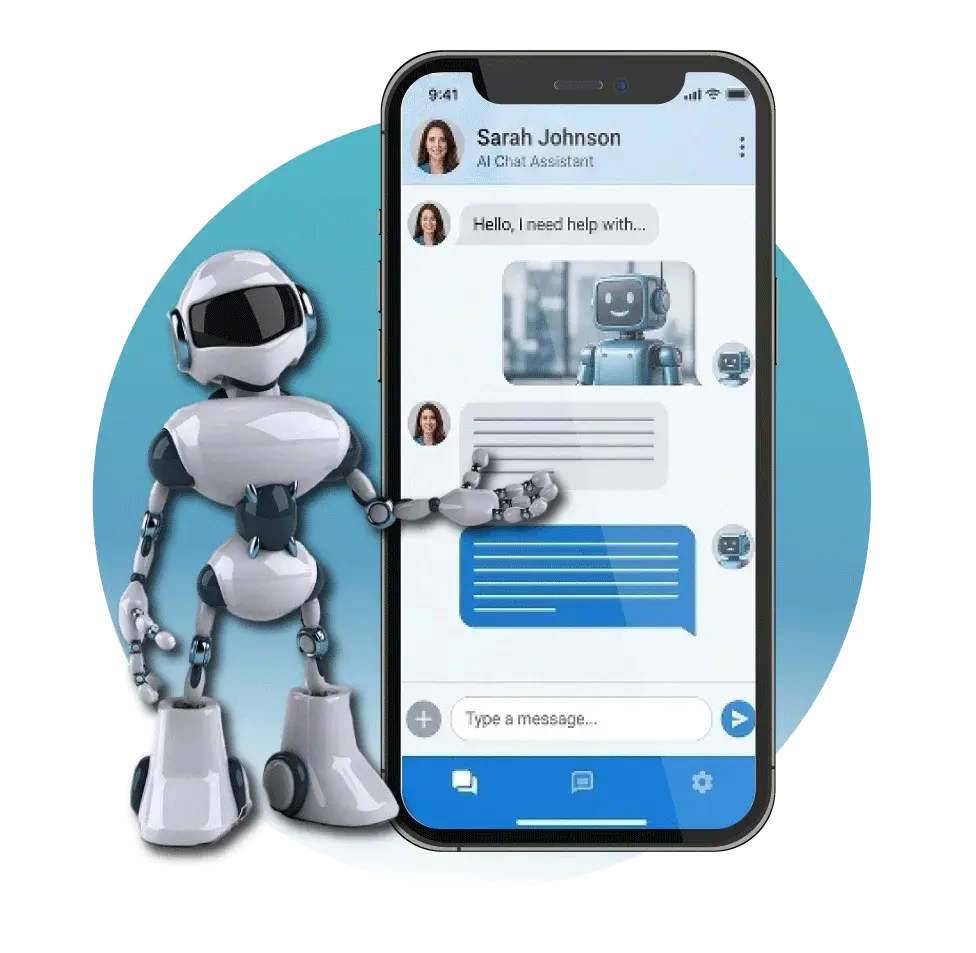
Digital Dividend built SupportSync AI, a multi-channel customer support platform that uses NLP to classify incoming queries, route tickets to the correct response flow, and learn from every resolved case. Post-launch, the platform reduced average first-response time by over 60% and handled the majority of routine queries without human intervention.

A digital illustration of a friendly AI robot standing next to a smartphone screen displaying a chat conversation, representing the AI Customer Support Platform for SupportSync AI by Digital Dividend.
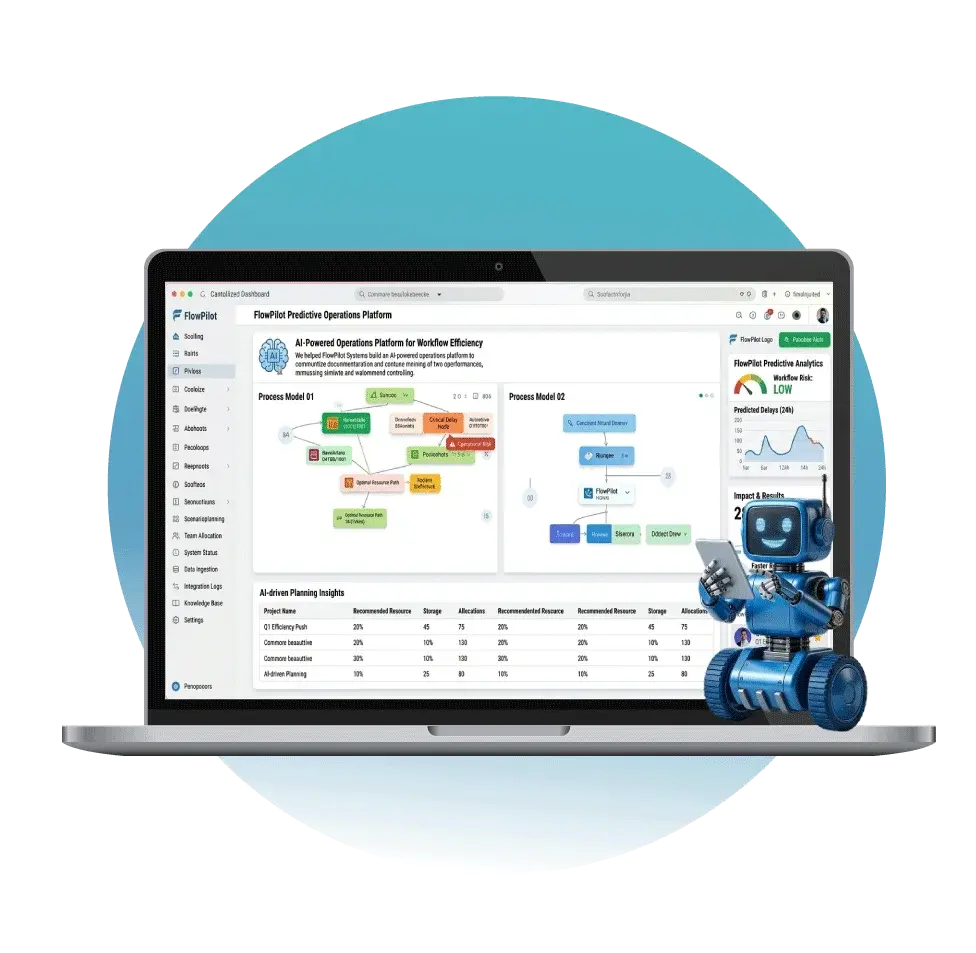
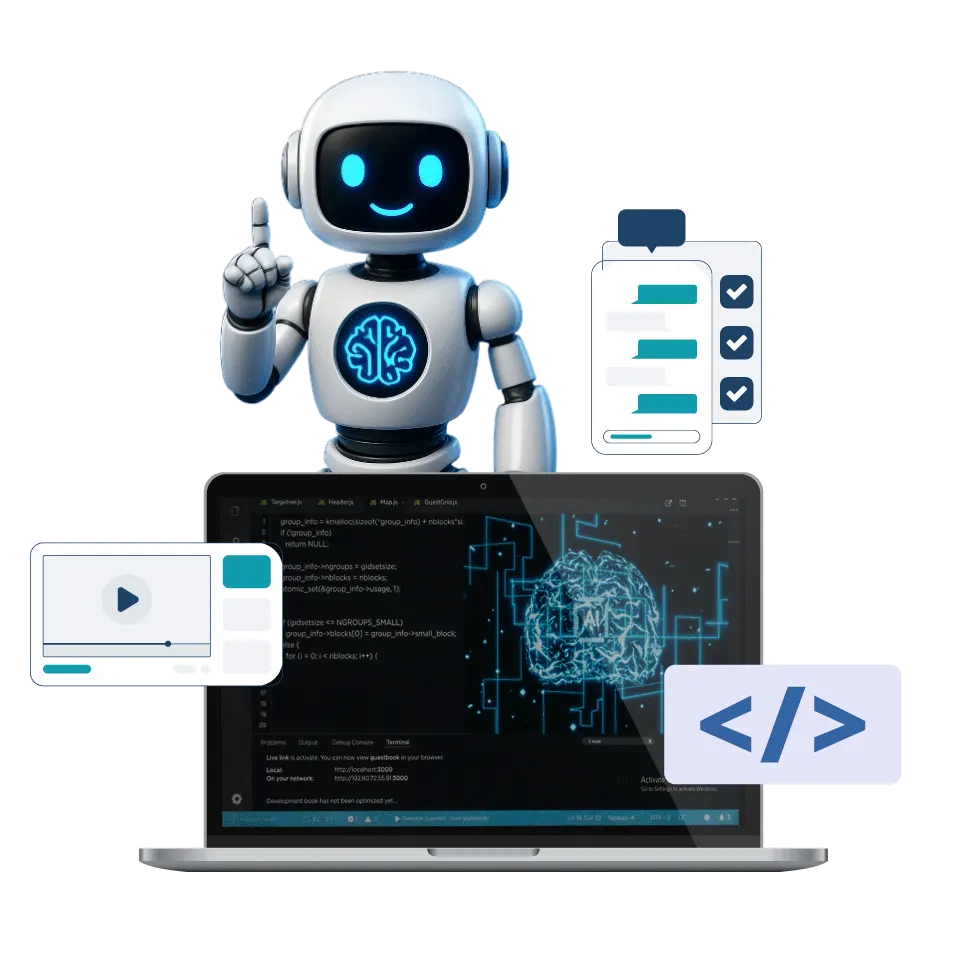
A laptop showing a Predictive Operations Platform for FlowPilot Systems dashboard with process models and efficiency charts, accompanied by a small blue robot assistant, built by Digital Dividend.

FlowPilot Systems — Predictive Operations with AI

FlowPilot Systems is an AI-powered predictive operations platform that uses real-time data streams and machine learning models to flag operational risks before they escalate. Digital Dividend built the data ingestion layer, the prediction engine, and the conversational alert interface that allows operations managers to query the system in plain language.

RUYAH — Enterprise AI Solution for the Oil Sector

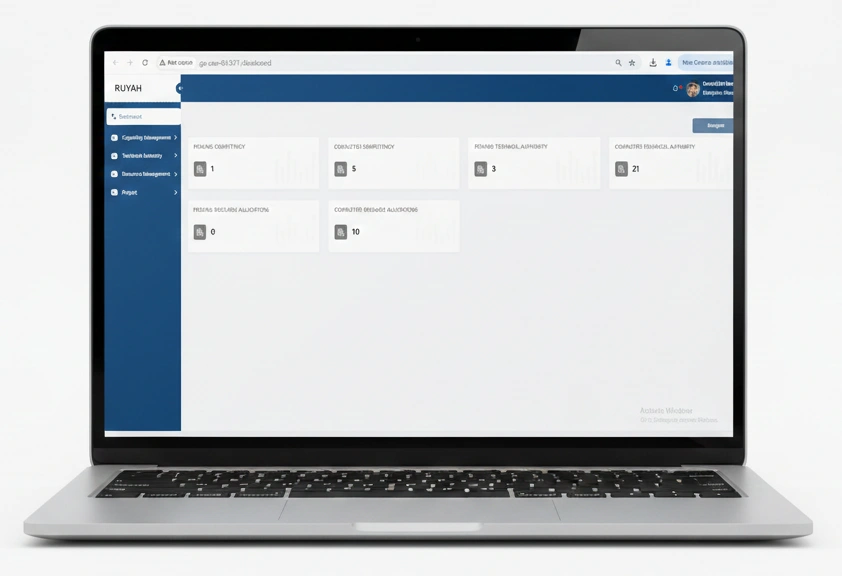
RUYAH is a resource allocation and workforce management platform built for a Middle Eastern oil sector client. The platform manages resource scheduling and communication for over 1,000 users across multiple departments, with an intelligent assistant layer that handles routine allocation queries and escalates exceptions to supervisors automatically.

Digital Dividend demonstration of the RUYAH – Discipline & Resource Management Platform mobile interface, showing an administrative dashboard or login screen across three devices.

Future-Ready Services for Digital Transformation

Digital Dividend offers future-ready solutions in software development, mobile apps, eCommerce, CMS, IoT, analytics, ERP, AI Software and healthcare innovation.

Scale your operations with expert AI virtual assistant solutions.

Digital Dividend develops intelligent virtual assistants that automate tasks, improve customer interactions, and boost efficiency.

Frequently Asked Questions

Start by defining the specific tasks the assistant must complete and the business outcomes it must support. Then evaluate your channel requirements, your integration complexity, your data availability for training, and the ongoing support model the vendor provides. A clear use case and realistic performance metrics will guide every other decision.

They handle FAQ resolution, order tracking, complaint triage, appointment scheduling, and live agent handoff, automatically and around the clock. A well-built customer service assistant resolves the majority of routine queries without human involvement, freeing your team for complex or high-value interactions.

Not entirely, and not for every task. AI assistants handle volume, consistency, and availability better than humans. Humans handle ambiguity, empathy, and complex judgment better than AI. The most effective deployments use AI to handle the routine and escalate the exceptional to skilled human agents.

A properly built AI assistant uses end-to-end encryption, GDPR-compliant data processing, role-based access controls, and audit logging. Digital Dividend includes a dedicated security review in every enterprise engagement and designs data handling in compliance with the regulations relevant to your industry and region.

A rule-based chatbot can be production-ready in four to six weeks. A custom NLP assistant with integrations typically takes two to four months from discovery to deployment. An enterprise multi-agent system with voice capability and compliance requirements may take four to eight months. Timeline depends on scope clarity, data availability, and integration complexity.

A traditional virtual assistant is a human who provides remote administrative support. An AI powered virtual assistant is software that uses machine learning and NLP to automate the same functions at scale, without human involvement. The key advantage is availability and volume: it operates continuously and handles thousands of simultaneous interactions.

Get Started with Your AI Virtual Assistant Project

Your customers expect fast, accurate responses at any hour. Your team deserves to spend their time on work that requires human expertise. A well-built AI virtual assistant delivers both reliably, at scale, and without the overhead of a larger headcount.
Digital Dividend has the experience, the team, and the process to build it right the first time. With 15+ years of software delivery experience and 100+ developers in-house, we are the AI virtual assistant development partner your business can rely on for the long term.

Trusted AI Virtual Assistant Development Services for Growing Businesses

Partner with AI virtual assistant development experts who build intelligent, scalable, and user-friendly solutions tailored to your business needs. Get started with a free 30-minute consultation.

circle-shape-with-line
bottom-banner-image

    This site is registered on wpml.org as a development site. Switch to a production site key to remove this banner.