Node.js development services
Get a free Node.js consultation — talk to our senior developers today.
What is Node.js used for?
Node.js is used to build server-side applications that need to handle high volumes of simultaneous requests without blocking other operations. Its event-driven, non-blocking I/O (input/output) architecture makes it the right choice for REST APIs (representational state transfer application programming interfaces), real-time applications like chat and live dashboards, streaming platforms, microservices architectures, and e-commerce backends where thousands of users interact with the same data simultaneously.
Node.js web development services are also used for backend-for-frontend (BFF) layers that aggregate data from multiple microservices into a single API response optimized for a specific client, such as a mobile app or a React front end. Because Node.js uses JavaScript on both server and client, teams that already work in React, Vue.js, or Angular can extend their JavaScript expertise to the backend without switching languages, reducing context switching and accelerating delivery.
What are the benefits of Node.js development services?
Node.js delivers significantly faster request handling than traditional thread-based server architectures because it processes multiple requests on a single thread using an event loop, eliminating the overhead of spawning new threads per connection. PayPal reported a 35% reduction in average response time after migrating their checkout backend to Node.js, while reducing server-side code by 33% (PayPal Engineering Blog, 2023).
Beyond performance, Node.js development solutions deliver three structural business advantages: a unified JavaScript codebase across front end and back end reduces team size and onboarding time, npm (Node Package Manager, the world’s largest software registry with over 2.1 million packages) accelerates development through a proven library ecosystem, and Node.js’s lightweight runtime makes it the most cost-effective option for cloud deployments where you pay per compute resource consumed.
Our Node.js development services
Our software development company delivers Node.js development services across seven structured service areas, each scoped to your architecture requirements, scale targets, and delivery timeline.
Node.js REST API development
Node.js real-time application development
Node.js microservices development
Node.js e-commerce development services
Node.js cloud application development
Migration to Node.js
Node.js maintenance and support
What are the best Node.js frameworks for development?
Framework selection depends on your application type and team architecture. Express.js remains the default choice for lightweight APIs and microservices because its minimal footprint and extensive middleware ecosystem make it the fastest path from zero to a working API endpoint. NestJS is the right choice for enterprise applications requiring strict TypeScript typing, dependency injection, and structured module architecture that scales across large engineering teams without becoming unmanageable.
Fastify outperforms Express.js in raw throughput benchmarks and is the preferred choice for high-volume APIs where latency directly affects user experience or infrastructure cost. Hapi.js (a configuration-first Node.js framework) suits applications requiring complex authentication and validation logic built into the framework rather than assembled from middleware. Our experienced developers with AI select the right framework based on your throughput requirements, team TypeScript fluency, and long-term maintenance considerations, not industry trends.
What industries use Node.js development?
Node.js development services for enterprises and startups alike are relevant across any industry where application performance, real-time data, or API scale are business-critical requirements.
- Fintech and financial services: high-frequency transaction APIs, real-time fraud detection systems, payment gateway backends, and banking dashboards. Node.js's non-blocking architecture handles concurrent financial transactions without the thread-per-request overhead that slows traditional server stacks at peak load.
- E-commerce and retail: product catalog APIs, cart and checkout backends, inventory sync services, and real-time stock update feeds. Node.js e-commerce development services consistently handle Black Friday-level traffic spikes that PHP and Rails backends require horizontal scaling to survive.
- Healthcare and health technology: real-time patient monitoring dashboards, EHR (electronic health record) API layers, and telemedicine platform backends. Our healthcare software development experience gives our Node.js developers the compliance context healthcare backends require.
- SaaS and product companies: multi-tenant API platforms, webhook delivery systems, real-time collaboration tools, and analytics data pipelines where Node.js's event loop handles thousands of simultaneous user sessions efficiently.
- Logistics and supply chain: real-time shipment tracking APIs, warehouse management system integrations, and IoT (Internet of Things) device data ingestion pipelines where Node.js processes high-frequency sensor events without blocking other application logic.
How does custom iPhone app development differ from template apps?
Compared to Python Django and Flask, Node.js delivers significantly higher concurrent request throughput for I/O-bound workloads because Python’s GIL (Global Interpreter Lock) limits true parallelism on CPU-bound tasks. For CPU-intensive tasks like machine learning inference or image processing, Python remains the stronger choice. Node.js and Python are frequently combined: Node.js handles the API layer and real-time connections while Python microservices handle the AI and data processing workloads behind the API.
Compared to PHP, Node.js scales more efficiently under concurrent load and requires no web server configuration layer like Apache or Nginx to handle requests, though PHP remains relevant for WordPress and Magento-based commerce platforms where the existing ecosystem justifies its use. Compared to Java Spring Boot, Node.js starts faster, consumes less memory per instance, and deploys more cheaply on serverless infrastructure, making it the preferred choice for startups and microservices teams optimizing for infrastructure cost. Our software development services team advises on the right backend stack for your specific performance, compliance, and cost requirements before any code is written.
What is the Node.js development process?
Our professional developers follow a four-stage Node.js development process with documented outputs and team sign-off at each stage, ensuring architecture decisions are made before development begins rather than corrected mid-build.
Discovery and architecture design
We define your API architecture, data models, authentication strategy, third-party integrations, and scaling approach before development begins. For microservices engagements, this stage produces a service map, an inter-service communication design, and a database architecture document. Because Node.js architecture decisions particularly around stateless vs. stateful design and synchronous vs. asynchronous data flows are expensive to reverse mid-project, formal architecture sign-off is non-negotiable.
Development and API build
Development runs in two-week agile sprints using TypeScript (a strongly typed superset of JavaScript) where applicable, with working API endpoints delivered to your team after every sprint via a staging environment. Every endpoint includes unit tests written in Jest (a JavaScript testing framework) and integration tests covering the full request-response cycle, so test coverage grows continuously rather than being written in a rush before release.
Testing and performance optimization
We run load testing using k6 (an open-source load testing tool) and Artillery (a Node.js-native performance testing framework) to validate that your API handles target concurrent user volumes within acceptable latency thresholds before production deployment. Performance optimization covers database query profiling, Redis caching layer implementation, connection pooling configuration, and Node.js cluster mode setup for multi-core CPU utilization.
Deployment and maintenance
We manage deployment to your chosen cloud provider using containerized Docker builds, automated CI/CD pipelines, and zero-downtime deployment strategies including blue-green and canary releases. Post-launch, our software development company provides structured maintenance covering npm dependency updates, Node.js LTS version upgrades, performance monitoring, and SLA-backed incident response.
What is the cost of Node.js development services?
Node.js development cost is driven by API complexity, the number of third-party integrations, real-time feature requirements, and the scale of concurrent load the system must handle. Because Node.js is open-source with no licensing fees, professional development time is the only cost variable.
| Project scope | Description | Estimated cost | Timeline |
|---|---|---|---|
| Simple REST API | CRUD endpoints, auth, basic integrations, single service | $8,000 – $20,000 | 3 – 6 weeks |
| Mid-complexity backend | Multi-service API, real-time features, payment integration | $20,000 – $55,000 | 6 – 14 weeks |
| Complex Node.js platform | Microservices, Kafka/RabbitMQ, multi-cloud, high concurrency | $55,000 – $150,000 | 14 – 32 weeks |
| Enterprise Node.js system | Full architecture, legacy migration, custom infrastructure | $150,000+ | 24 – 52 weeks |
Affordable Node.js development services for startups typically start with a scoped MVP API build and expand iteratively. Our software development agency provides a fixed-scope cost estimate after the architecture design stage, so your budget is confirmed before a single line of production code is written.
How to choose Node.js development services?
The most important technical signal when evaluating Node.js development companies is whether they use TypeScript as a standard practice rather than plain JavaScript for production backends. TypeScript catches an entire class of runtime errors at compile time, reducing production incidents significantly on large Node.js codebases. Providers who default to plain JavaScript for new production Node.js projects are taking on avoidable technical debt that compounds as the codebase scales.
Verify that the provider writes tests as part of development, not as a post-development task. Node.js backends without test coverage are fragile under dependency updates and feature additions. Check for documented CI/CD pipelines, load testing evidence, and API documentation as standard deliverables. Digital Dividend delivers all three on every engagement, with project leadership from our experienced teams in Sweden and the USA. Read our blog on software development outsourcing or explore our hire developer page to understand how we structure Node.js team engagements.
Ready to scope your Node.js project? Book a free consultation with our senior developers.
Node.js development: real results
Our software development company has delivered Node.js-powered API platforms, AI backends, and real-time operational systems across legal, healthcare, procurement, and e-commerce sectors. Explore our full case studies portfolio for detailed delivery evidence.
AppNavi — enterprise software guidance platform
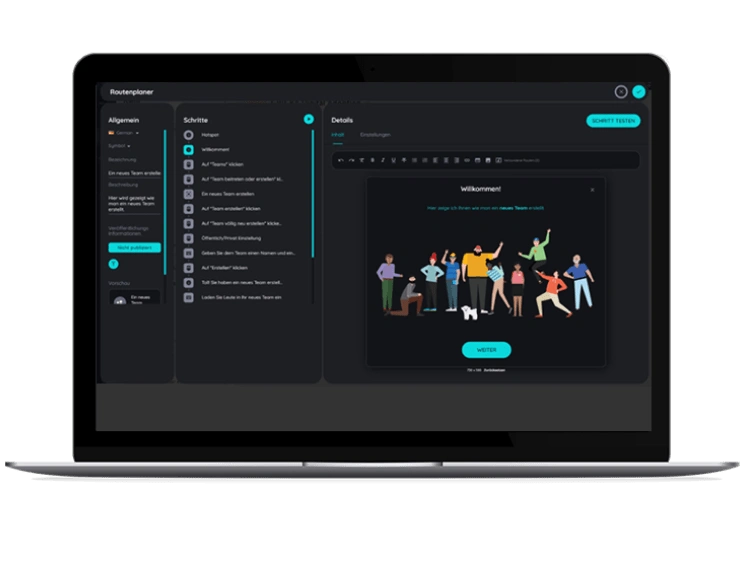
We built and scaled AppNavi’s backend infrastructure, delivering a high-availability API platform serving enterprise clients across Germany and the wider European market. The Node.js backend handled concurrent user sessions across multiple enterprise deployments simultaneously, with a structured CI/CD pipeline and documented API layer that allowed the client’s in-house team to extend the platform independently after handover.
AI-powered legal intelligence platform
We built the backend API layer for an AI-powered legal research platform, handling document ingestion, entity extraction pipeline orchestration, and real-time search query processing simultaneously. The Node.js API layer connected a React front end to Python-based AI microservices using an async message queue architecture, delivering sub-second search results across large legal document corpora without blocking other platform operations.
SupportSync AI — AI customer support platform
We delivered the real-time backend for SupportSync AI, a customer support automation platform handling concurrent live chat sessions, AI response generation, and CRM integration simultaneously. The Node.js event loop architecture was specifically chosen because it handles hundreds of simultaneous open WebSocket connections without the memory overhead that thread-per-connection server architectures impose at scale.
WhatsApp-powered B2B procurement automation
We built the Node.js API integration layer connecting WhatsApp’s Business API to a live ERP procurement module, processing inbound buyer messages, triggering purchase order creation, and routing supplier responses in real time. The event-driven Node.js architecture handled the asynchronous message flow between three systems simultaneously without blocking or data loss under peak procurement traffic.
Our delivery track record
With 15+ years of experience, 300+ projects delivered, and 100+ in-house developers across the US, Europe, and GCC, every Node.js system we build is grounded in real production API and backend delivery experience across high-concurrency, data-intensive platforms.
Enhance Your Project with Our Related Services
At Digital Dividend, we specialize in software, mobile apps, eCommerce solutions, CMS development, IoT systems, analytics, and healthcare technologies.
Expand your development capabilities with top-tier Node.js experts.
Digital Dividend supplies qualified Node.js developers to accelerate project delivery and power modern web applications.
Frequently Asked Questions
Is Node.js suitable for large applications?
Yes. LinkedIn, Netflix, PayPal, Uber, and Microsoft all run large portions of their backend infrastructure on Node.js at scales of millions of concurrent users. Node.js scales horizontally through clustering (running multiple Node.js processes across CPU cores), containerization with Docker and Kubernetes, and stateless API design that distributes load across multiple server instances behind a load balancer. The key architectural requirement for large Node.js applications is keeping CPU-intensive work out of the event loop by offloading it to worker threads or separate microservices.
How does Node.js handle concurrency?
Node.js handles concurrency through an event loop: a single-threaded mechanism that processes I/O operations asynchronously without blocking. When a Node.js server receives a database query request, it does not wait for the response before processing the next incoming request. Instead, it registers a callback and continues processing other requests until the database response arrives. This approach allows a single Node.js process to handle thousands of concurrent I/O-bound requests with the memory footprint of a single thread rather than thousands.
Can Node.js be used for mobile app development?
Node.js itself runs on servers, not on mobile devices. However, Node.js is commonly used as the backend API server for mobile applications built in React Native, Flutter, or native iOS and Android. For building cross-platform mobile apps using JavaScript, React Native (which uses JavaScript but runs native UI components, not Node.js) is the relevant technology. Our React Native development services and MERN stack development teams deliver the full stack: Node.js backend and JavaScript mobile frontend together.
How to hire Node.js developers?
When hiring Node.js developers, verify TypeScript proficiency, test-writing discipline, and experience with async programming patterns including Promises, async/await, and event emitters. Ask for code samples demonstrating error handling in async functions and load test results from a live production system they have built. Avoid developers who cannot explain the event loop clearly or who write synchronous blocking code in Node.js contexts, as this eliminates the primary performance advantage of the runtime.
What are the limitations of Node.js?
Node.js is not the right choice for CPU-intensive workloads such as video transcoding, complex mathematical computation, or machine learning model training, because heavy CPU work blocks the event loop and degrades performance for all concurrent requests. Node.js callback-heavy codebases can become difficult to maintain without disciplined use of async/await and TypeScript typing. For CPU-bound tasks, Python, Go, or Java are stronger alternatives, and are frequently deployed as separate microservices alongside a Node.js API layer in mixed-stack architectures.

What our clients say
Ready to build with Node.js?
Whether you need a high-throughput REST API, a real-time platform, a microservices backend, or a Node.js migration from a legacy stack, Digital Dividend has the in-house development capability to deliver it at production standard. Our expert developers handle every stage from architecture design through deployment and post-launch maintenance. Explore our MEAN stack development and AI software development services to see how we combine Node.js with AI and full-stack JavaScript architectures.