AI Visual Inspection: How It Works, Key Benefits, and Where It Delivers Value
What Is AI Visual Inspection?
Every manufacturer, electronics maker, and healthcare device producer faces the same question: how do you catch a defect before it reaches a customer? AI visual inspection answers that question by pairing cameras with machine learning models that recognize flaws a human eye might miss, at a speed no inspection line staffed only by people could match. Visit Digital Dividend’s homepage to see how our team approaches AI-driven engineering projects like this one.
At its core, AI visual inspection combines high-resolution imaging with computer vision algorithms, usually convolutional neural networks, that have been trained to recognize what a defect-free product looks like. When something deviates from that baseline, the system flags it instantly.
This isn’t a rebrand of older machine-vision tooling. Traditional machine vision relies on fixed, rule-based logic: a part is a certain size, a certain color, or it fails. AI visual inspection learns from labeled examples, so it can generalize to defects it hasn’t seen in exactly that form before.
How Does AI Visual Inspection Work?
Building a working AI visual inspection system involves three connected stages: gathering and labeling training data, building and training the computer vision model, and deploying that model where it can act on live production data.
Data Collection and Annotation
Everything starts with images: thousands of examples of acceptable and defective products, captured under consistent lighting and angles. Each image is labeled to tell the model what it’s looking at, a process that determines how well the system will perform later. Teams that treat this step as an afterthought end up with models that don’t generalize. This is the same discipline our data engineering team applies on every AI project clean, well-structured data pipelines before any model gets built.
Computer Vision Algorithms and Model Training
Once the dataset is ready, engineers train a computer vision model, typically a convolutional neural network, to distinguish normal from defective. The model is tested against images it has never seen, and accuracy is measured before anything goes near a live production line. Our AI software development team follows this same train-validate-test discipline for every custom AI build, not just inspection systems.
Deployment and Continuous Improvement
A trained model isn’t a finished product. It needs to run somewhere often on edge hardware near the production line for low latency and it needs a feedback loop so it keeps improving as new defect types appear. Our AI agent development work covers exactly this kind of ongoing, monitored deployment, where a system doesn’t just ship once and get forgotten.
AI Visual Inspection vs. Traditional Inspection
Manual inspection isn’t obsolete for low-volume or highly variable products, a trained human is often still the right call. But as volume and consistency requirements rise, the gap widens.
Factor
Manual Inspection
AI Visual Inspection
Speed
Limited by human throughput
Processes images in near real time
Consistency
Varies by inspector, shift, fatigue
Applies the same criteria every time
Scalability
Requires more staff to scale
Scales across lines with added compute
Data logging
Manual notes, inconsistent records
Every inspection automatically logged
Upfront cost
Low
Higher cameras, models, integration
Best fit
Low-volume, highly variable products
High-volume, repeatable inspection tasks
Key Benefits of AI Visual Inspection
Increased Accuracy and Consistency
A model applies the same criteria to the one-thousandth part as it did to the first, which removes the fatigue and shift-to-shift variability that come with manual review.
Cost Savings and Operational Efficiency
Catching a defect earlier in the process is almost always cheaper than catching it after shipping. Fewer escaped defects mean fewer returns, less rework, and less time spent on manual re-checks.
Scalability Across Production
Adding inspection capacity with people means hiring and training. Adding it with AI visual inspection means deploying the same trained model to another camera and compute node a fundamentally different scaling curve.
Industries and Use Cases
Manufacturing and Automotive
Assembly lines use AI visual inspection to catch surface defects, misalignments, and missing components at production speed, before a part moves to the next station.
Electronics and Semiconductor
Circuit boards and chips involve defects too small and too frequent for reliable manual review, which makes this one of the earliest and strongest adoption areas for computer vision quality control.
Healthcare and Pharmaceutical
Device manufacturers and pharmaceutical packaging lines use AI visual inspection to verify labeling, seals, and physical integrity under strict regulatory scrutiny. Digital Dividend’s healthcare software development team works inside exactly this kind of compliance-heavy environment, building software that has to be right the first time.
Food and Textile
From contamination detection to fabric flaw checks, food and textile producers use the same underlying computer vision techniques, adapted to their own defect types and lighting conditions.
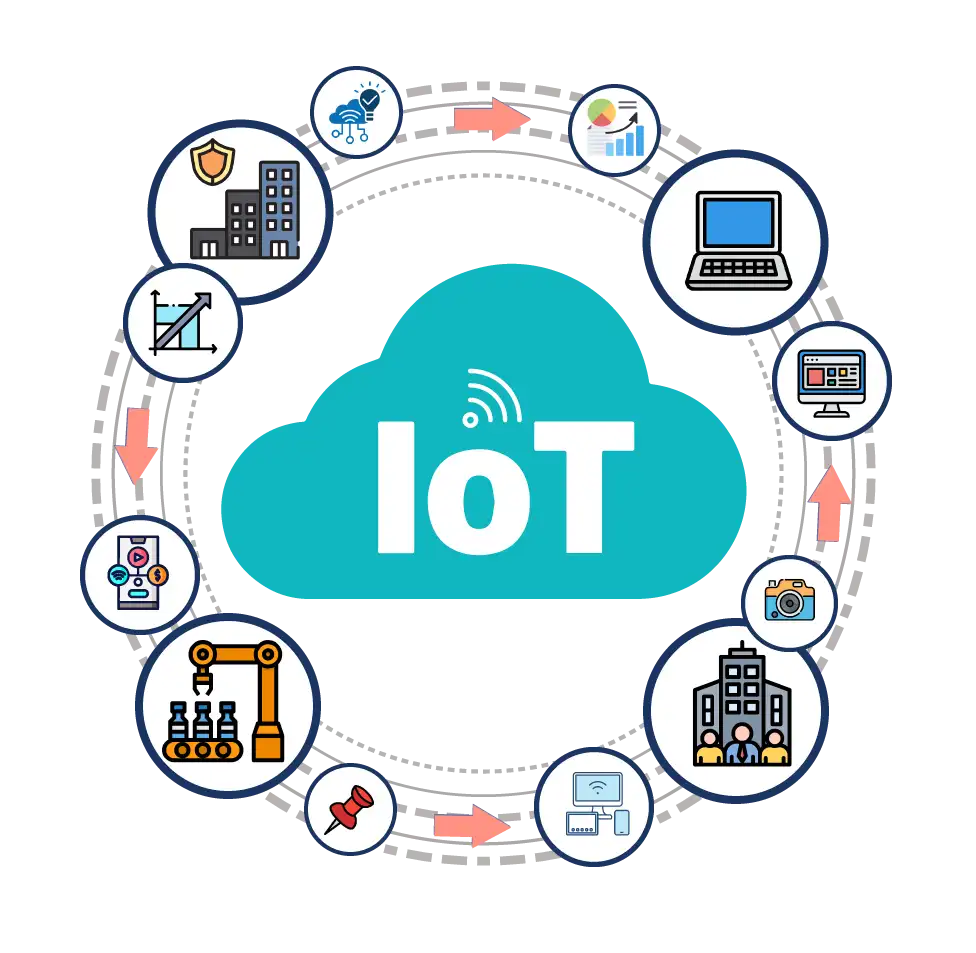
Much of this depends on hardware that talks to software in real time cameras, sensors, and edge devices working together. That’s the same territory our emerging technologies and IoT work lives in, even outside a factory floor.
Challenges and Limitations
Data Quality and Dataset Requirements
A model is only as good as its training data. Rare defect types are, by definition, rare in the dataset, which makes them the hardest to catch reliably.
Integration with Existing Systems
An inspection model has to talk to the PLCs, MES platforms, and quality databases already running the line integration work that’s often underestimated at the planning stage. Our enterprise application services team handles this kind of legacy-to-modern system integration regularly.
Ongoing Model Maintenance
Production lines change: new product variants, new lighting, new camera hardware. A model needs monitoring and periodic retraining, not a one-time deployment.
What Does It Cost to Implement?
Costs generally break down into three buckets: upfront hardware (cameras, lighting, edge compute), the model development and training work itself, and ongoing costs for retraining, monitoring, and system integration. Pilot projects on a single line cost far less than a multi-site rollout, and most teams are better served starting narrow one high-value inspection point before scaling out.
Because so much of the cost sits in data and analytics work rather than hardware, teams considering this investment often benefit from an analytics-first assessment before committing to a specific vendor or platform.
How Digital Dividend Builds the AI Engineering Behind Inspection Systems
Digital Dividend isn’t a machine-vision hardware vendor. What we bring is the AI and IoT software engineering that sits underneath systems like these: data pipelines, model training and deployment, and the integration layer that connects cameras and sensors to the rest of a business’s software stack.
Our work on the Smart Ventilation System project involved exactly this kind of sensor-to-software pipeline real-time data from physical hardware, processed and acted on automatically. Our IoT Asset Tracking case study is a similar story: physical devices feeding a software layer that has to make decisions in near real time.
As a software development agency with dedicated AI, data engineering, and IoT teams, Digital Dividend builds the custom software layer that turns hardware data into decisions whether that’s an inspection line, a monitoring system, or an internal quality dashboard.
How to Get Started
Identify one high-value inspection point where defects are costly to catch late.
Audit what data you already have images, sensor logs, existing QA records.
Scope a pilot on a single line before planning a multi-site rollout.
Plan the integration layer early PLCs, MES, and quality databases rarely connect cleanly on the first try.
If you’re weighing whether a custom-built approach or an off-the-shelf platform makes sense for your operation, our AI software development team can walk through the tradeoffs with you.
Enhance Your Project with Our Related Services
At Digital Dividend, we specialize in software, mobile apps, eCommerce solutions, CMS development, IoT systems, analytics, and healthcare technologies.
Mobile App Development Services:
Software, Web & Design Services:
eCommerce Development Services:
Restaurant App Development:
AI Software Development Services:
ERP Software Development Services:
CMS Development Services:
IoT, Wearables & Data Services:
Healthcare Product Development for Startups:
Accelerate quality assurance with top-tier AI visual inspection experts.
Digital Dividend delivers scalable AI-powered inspection systems that optimize production, improve accuracy, and reduce operational costs.
AI visual inspection uses computer vision and machine learning to automatically detect defects, anomalies, or quality issues in images of products, replacing or supplementing manual visual checks.
A model is trained on labeled images of acceptable and defective products, then deployed to analyze live images and flag deviations from the trained baseline in real time.
Manufacturing, automotive, electronics, semiconductor, healthcare device production, pharmaceuticals, food processing, and textiles are among the most common adopters.
In most deployments, AI handles high-volume, repeatable checks while people manage edge cases, ambiguous defects, and process oversight — a hybrid model rather than a full replacement.
Cost depends on hardware needs, dataset size, and integration complexity. A single-line pilot is significantly cheaper than a multi-site rollout, which is why most teams start narrow.
Conclusion
AI visual inspection is fundamentally a software and data problem wearing a hardware hat: cameras capture the images, but the value comes from the model training, data pipelines, and system integration underneath. Whether you’re evaluating a purpose-built inspection platform or considering a custom-built system, Digital Dividend can help you think through the AI engineering that makes it work.
Ready to talk through what a custom AI or IoT project could look like for your operation? Contact Digital Dividend for a free consultation.
This site is registered on wpml.org as a development site. Switch to a production site key to remove this banner.