





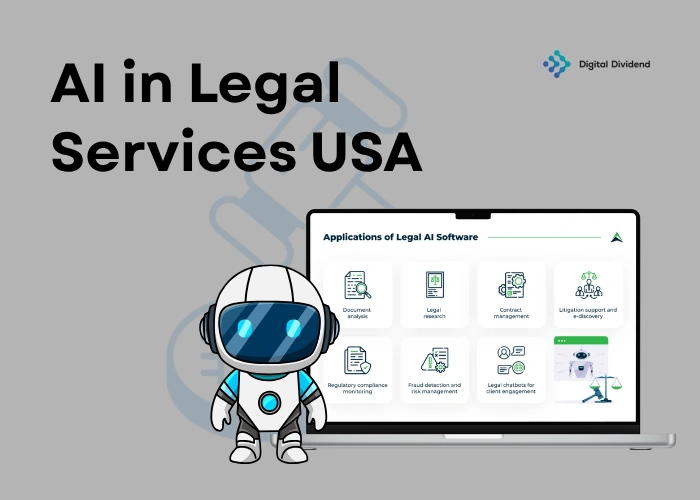
AI is making legal services accessible in the USA by automating research, enabling 24/7 chatbot support, and reducing consultation costs. Law firms, legal aid organizations, and pro bono programs use AI tools to serve more clients efficiently removing geographic and financial barriers that once limited access to justice for millions of Americans.
Artificial Intelligence is transforming legal services across the United States. From faster research to automated document analysis and intelligent client support, AI in legal services USA enables it to become a practical reality not just a trend. Law firms, legal aid organizations, and startups can deploy AI-driven tools to deliver reliable guidance while cutting operational costs and manual workloads (Thomson Reuters, 2025).
For underserved communities, AI increases accessibility to legal resources through 24/7 support, bridging geographic and socio-economic gaps. Platforms built around agentic AI research assistants and AI-powered chatbots help lawyers and clients retrieve statutes, precedents, and legal guidance in minutes.
Digital Dividend, as a software development company, provides expert developers and professional teams to build these AI-enabled platforms ensuring scalable, secure, and compliant legal solutions.
How AI is Changing Legal Access in the United States
AI is reshaping the US legal landscape by automating research, streamlining case management, and providing instant access to statutes and precedents. Law firms, legal aid organizations, and pro bono initiatives can now reach clients more efficiently reducing dependency on manual processes and improving overall access to justice (Thomson Reuters, 2025).
Today, 79% of legal professionals use AI matching adoption rates in other industries while large law firms show the highest uptake at 87% (Clio Legal Trends Report, 2025).
Definition of AI Applications in Legal Accessibility
AI applications include agentic research assistants, intelligent chatbots, and predictive analytics tools. These solutions help lawyers and clients navigate complex legal frameworks, improving efficiency and accuracy especially for underserved populations who previously faced geographic or financial barriers (Yale Law Journal, 2026).
Key Challenges in Traditional Legal Services
- Fragmented legal databases across federal and state systems
- High attorney costs and limited availability in rural areas
- Inefficient manual research leading to slow case preparation
- Geographic barriers that prevent equitable access to counsel
Examples of AI Platforms Bridging Access Gaps
| Platform | Function | Key Impact |
|---|---|---|
| CoCounsel Legal | AI-powered case management | Reduces research time by up to 80% |
| Agentic AI Research Assistant | Precedent and statute retrieval | Provides real-time 24/7 access to legal information |
| Legal Chatbots | Client guidance and procedural support | Improves reach for small firms and pro bono programs |
What Role Does AI Play in Legal Accessibility for Americans?
AI plays a critical role in expanding access to legal services in the USA. It automates complex research, reduces administrative burdens, and delivers timely guidance. Legal aid organizations, small law firms, and pro bono initiatives use AI to serve a wider client base — while maintaining accuracy and compliance (Pro Bono Institute, 2026).
Improving Legal Research Efficiency
AI tools from agentic research assistants to semantic search engines help lawyers retrieve relevant case law, statutes, and precedents in minutes rather than hours. They also highlight critical arguments, reducing errors and improving case preparation speed. Our AI software development service delivers exactly this kind of intelligent legal infrastructure.
Enhancing Access for Low-Income Individuals
- 24/7 access to legal information via AI-powered chatbots
- Reduced dependency on expensive attorney consultations
- Equitable legal services across geographic and socio-economic boundaries (Yale Law Journal, 2026)
Democratization of Legal Knowledge
AI democratizes legal knowledge by indexing court decisions, regulations, and statutes in a centralized, searchable format. This empowers citizens, small law firms, and advocacy groups to access high-quality legal information independently fostering fairness, transparency, and informed decision-making (Brookings Institution, 2026).
How Does AI Help in Providing Legal Services to Underserved Communities?
AI improves legal access for underserved communities by reducing dependency on in-person consultations and manual research. By automating routine tasks, law firms, legal aid organizations, and pro bono programs can reach more clients efficiently. Notably, 88% of legal aid professionals see AI as a tool to address the justice gap (LawNext Survey, 2025).
AI-Powered Research Assistants and Chatbots
Agentic AI research assistants and chatbots provide real-time legal information, answer procedural questions, and guide users through filings. These tools allow individuals to access accurate legal guidance 24/7, reducing delays and ensuring equitable service for low-income populations. Our AI agent development services help legal platforms deploy these solutions effectively.
Automated Document Analysis and Legal Guidance
AI platforms analyze contracts, pleadings, and court documents to extract key insights and precedents. This automation saves hours of manual work, ensures compliance with legal standards, and enables lawyers to focus on high-value tasks (Yale Law Journal, 2026).
Case Examples Improving Access for Marginalized Groups
- Legal Aid Society: AI chatbots and research assistants provide 24/7 access to legal information
- Equal Justice Works: Automated document analysis streamlines pro bono services
- Research time reduced by up to 80%, enabling faster case resolution (Brookings Institution, 2026)
What Benefits Does AI Bring to Legal Access in the USA?
AI delivers measurable benefits by reducing the time and cost associated with case research and client interactions. Organizations can serve more clients efficiently while maintaining accuracy and compliance (Thomson Reuters, 2025).
Time Savings and Cost Efficiency
- Automates legal research, document review, and precedent retrieval
- Reduces research time by up to 80% for law firms and legal aid organizations
- Frees lawyers to focus on strategy, negotiation, and client counseling (Pro Bono Institute, 2026)
24/7 Availability for Legal Information
AI-powered chatbots and research assistants provide continuous access to legal information. Clients and attorneys retrieve statutes, case law, and guidance at any time improving responsiveness for rural and underserved populations. Digital Dividend’s AI virtual assistant development services power this kind of always-on legal support.
Reduced Dependency on In-Person Consultations
- Virtual guidance for initial assessments and document filings
- Scalable and inclusive service delivery for nonprofits and small firms
- Optimizes attorney workload while expanding reach to underserved populations
How is AI Transforming the Way People Access Legal Help in America?
AI is reshaping legal access in the US by integrating intelligent tools directly into platforms, apps, and legal workflows. The share of legal organizations actively integrating generative AI rose from 14% in 2024 to 26% in 2025, and 45% of law firms plan to make it central to their workflow within a year (Thomson Reuters, 2025).
Integration with Online Platforms and Apps
Embedded AI in web and mobile apps creates virtual legal portals for filing and case tracking. Digital Dividend’s mobile app and AI software development expertise help legal organizations build accessible, user-friendly platforms.
Multi-Dimensional Legal Search Using AI
- Analyzes statutes, precedents, and legal arguments simultaneously
- Provides actionable insights for faster, more accurate case preparation
- Reduces research time and human error significantly (Yale Law Journal, 2026)
Enhancing Client-Lawyer Interactions
AI summarizes legal options, flags critical documents, and automates routine client communications. This improves both the efficiency and the quality of legal services especially for high-volume pro bono practices.
How Are Legal Professionals Using AI to Enhance Access to Justice?
Legal professionals leverage AI to streamline case preparation, improve accuracy, and expand client reach. AI adoption is not just happening in large firms legal aid organizations are embracing AI at twice the rate of other lawyers (LawNext Survey, 2025).
AI-Assisted Case Preparation and Analysis
Professional developers at Digital Dividend build tools that analyze statutes, precedents, and case data to reduce research time by up to 80%. See our work in action through the SuportSync AI case study, which demonstrates how AI platforms streamline complex workflows.
Improving Procedural Fairness and Compliance
- AI flags inconsistencies and potential biases in legal documents
- Supports equitable legal outcomes and compliance with US ethical standards
- Maintains audit trails for transparency and regulatory accountability (Brookings Institution, 2026)
Adoption of AI Platforms in Law Firms and Pro Bono Services
AI scales services for small firms and non-profits. Our generative AI development services help legal organizations implement tools that improve client engagement and expand access for low-income communities.
What Are the Implications of AI on Legal Rights in the USA?
AI affects fairness, access, and compliance in legal services. When implemented responsibly, it ensures individuals receive timely and accurate legal guidance while protecting civil liberties (Thomson Reuters, 2025).
Ensuring Equitable Access to Legal Information
AI provides uniform access to statutes, case law, and procedural guidance reducing disparities for rural or low-income populations who previously relied on expensive in-person consultations.
Mitigating Biases and Maintaining Transparency
Bias detection algorithms and transparency mechanisms ensure AI decisions remain auditable and compliant with US ethical standards. This is critical for platforms serving vulnerable communities (Brookings Institution, 2026).
Role of AI in Shaping Legal Policy and Advocacy
AI tools provide data-driven insights for legislators and advocacy groups, supporting evidence-based policy reforms. Organizations can explore data and analytics services to leverage these insights effectively.
How AI Tools Are Being Used to Assist Legal Aid Organizations in the US
Streamlining Pro Bono Legal Services
AI automates client intake, case prioritization, and document management reducing administrative burden and freeing attorneys for client-facing work (Thomson Reuters, 2025).
Automating Repetitive Research and Case Management
AI research assistants extract key precedents and summarize statutes, allowing lawyers to focus on strategy rather than information retrieval. Digital Dividend’s data engineering services support the data pipelines that power these legal AI tools.
Improving Outreach to Low-Income Populations
- 24/7 AI chatbots and online portals reduce reliance on walk-in clinics
- Targeted digital outreach extends services to underserved geographic areas
- Integration with court systems improves filing accuracy and speed (Brookings Institution, 2026)
Specific AI Technologies Improving Access to Legal Services in the USA
| Technology Type | Purpose | Benefit |
|---|---|---|
| NLP Models | Contract and document analysis | Extracts key precedents and clauses efficiently |
| AI Chatbots & Virtual Assistants | Legal guidance and client triage | Provides instant, 24/7 access to legal information |
| Predictive Analytics | Case outcome modeling | Supports strategic decision-making for lawyers and clients |
| AI Search Engines | Case law and statute retrieval | Multi-dimensional search reduces research time and errors |
Limitations, Risks, and Governance of AI in Legal Services
AI offers significant benefits, but it also introduces risks that legal organizations must manage carefully. Human oversight remains essential 96% of legal professionals believe allowing AI to represent clients in court would go too far (Thomson Reuters, 2025).
What Are the Limitations of AI in Providing Legal Access?
- AI cannot replace human judgment in complex or emotionally sensitive cases
- Incomplete datasets can produce inaccurate or misleading legal guidance
- Mitigation requires supervised AI workflows and regular model audits (Pro Bono Institute, 2026)
What Are the Risks of Relying on AI for Legal Services?
- Accuracy risks: Inaccurate output from poorly trained models
- Privacy risks: Exposure of sensitive legal data without proper encryption
- Regulatory risks: Non-compliance with US state bar ethics rules and ABA guidelines
- Best practice: Use hybrid AI + human review workflows to minimize legal and reputational exposure
How Is AI Regulated in the Context of Legal Services?
Current US frameworks include ABA Model Rules on technology competence, state bar guidance, and the NIST AI Risk Management Framework. Future regulatory direction points toward mandatory audit trails, bias disclosures, and ethics certifications for AI platforms serving legal functions (Brookings Institution, 2026).
The Future of AI in Legal Access in America
AI is expanding access, improving efficiency, and enabling predictive legal insights for law firms, startups, and pro bono organizations. The share of legal organizations actively integrating AI doubled from 14% to 26% in just one year (Thomson Reuters, 2025) a trajectory that signals rapid maturation
Predictions for AI Adoption in Law by 2030
- 60% of US law firms expected to adopt AI-powered research and guidance systems (Pro Bono Institute, 2026)
- 45% of law firms already plan to make generative AI central to their workflow within one year (Thomson Reuters, 2025)
- AI-driven document automation and predictive analytics will become standard practice in enterprise legal teams
Emerging Trends in AI-Driven Legal Solutions
- Agentic AI assistants that autonomously research, draft, and file court documents
- Predictive analytics for case outcome modelin see how Digital Dividend’s FlowPilot predictive operations platform applies similar intelligence to complex workflows
- AI-powered document review and e-discovery at scale (Brookings Institution, 2026)
Opportunities for Small Firms and Underserved Clients
Affordable, 24/7 AI guidance allows small law firms to compete with larger practices. Digital Dividend’s healthcare software development experience demonstrates our ability to build compliant, AI-powered platforms in highly regulated industries a model directly applicable to legal tech.
Frequently Asked Questions
What is the significance of AI in the legal field?
AI automates legal research, analyzes complex datasets, and provides predictive insights allowing law firms and legal aid organizations to serve more clients efficiently. It improves accuracy, reduces manual errors, and enhances decision-making in both pro bono and enterprise legal services. Read our blog on AI-powered innovation in software for a broader perspective (Pro Bono Institute, 2026).
How does AI differ from traditional legal services?
Unlike traditional services, AI can process large volumes of legal documents instantly, provide 24/7 guidance through chatbots, and deliver data-driven recommendations. Human lawyers focus on strategy and nuanced interpretation, while AI handles repetitive tasks reducing time and costs (Thomson Reuters, 2025).
What specific legal areas are impacted by AI technology?
AI is significantly impacting legal research, regulatory compliance, contract analysis, case law review, and pro bono services. These areas benefit from faster information retrieval, predictive modeling, and scalable client support particularly for underserved or low-income populations (Yale Law Journal, 2026).
How do AI systems ensure fairness in legal access?
AI ensures fairness by detecting biases, providing transparency in decision-making, and maintaining equitable access to legal resources. Platforms are audited to comply with US ethical standards, ensuring clients from all demographics receive consistent and unbiased support (Brookings Institution, 2026).
What are the risks of relying on AI for legal services?
Risks include inaccuracies from incomplete datasets, privacy breaches, misinterpretation of AI guidance, and regulatory non-compliance. Mitigation requires human oversight, secure data handling, and transparent workflows to protect legal and reputational interests (Pro Bono Institute, 2026).
How can Digital Dividend help build AI-powered legal platforms?
Digital Dividend is a trusted software development agency with experienced developers who specialize in AI-enabled solutions for regulated industries. From AI agent development to enterprise application services, we build platforms that are scalable, secure, and compliant.
Conclusion
AI is fundamentally transforming legal services in the USA making them more accessible, efficient, and equitable. From automating research to providing 24/7 guidance, law firms and underserved populations benefit from faster, more reliable legal support. With 79% of legal professionals now using AI and legal aid organizations adopting it at twice the industry rate, the momentum is clear (Thomson Reuters, 2025; LawNext, 2025).
By combining AI tools with human oversight, legal aid organizations, startups, and law firms can enhance case preparation, reduce costs, and improve outcomes. Digital Dividend, as a software development company with expert developers and deep AI capabilities, delivers AI-enabled solutions that empower legal service providers to reach more clients, ensure fairness, and maintain compliance with US ethical and regulatory standards.
Ready to build a compliant, AI-powered legal platform? Contact Digital Dividend today for a free consultation and discover how our professional developers can transform your legal service delivery.
👉 Get in touch with Digital Dividend — your trusted software service provider for AI-driven legal solutions.
