





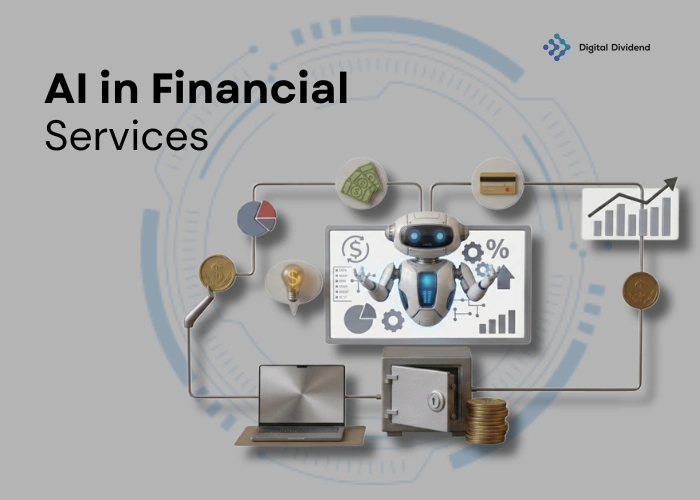
AI in financial services refers to the use of machine learning, natural language processing, and agentic systems to automate decisions, detect fraud, personalise products, and manage risk across banking, insurance, and investment. Financial institutions using AI report 25–40% cost reductions, near-instant fraud detection, and significantly faster credit decisioning.
Artificial intelligence is no longer an emerging capability in financial services it is the operating layer that defines competitive advantage. From fraud detection systems processing billions of transactions per second to agentic AI autonomously managing complex compliance workflows, AI in financial services is reshaping every function across banking, insurance, wealth management, and fintech.
This guide covers how financial institutions are deploying AI today, what measurable benefits they are achieving, what risks they must manage, and what trends will define the next five years of AI-driven finance.
At Digital Dividend, we build custom AI solutions for fintech, banking, and financial services businesses from fraud detection engines to agentic compliance systems. Everything in this guide reflects production-grade AI deployment, not theoretical capability.
What Is AI in Financial Services?
AI in financial services is the application of machine learning, deep learning, natural language processing, and autonomous AI systems to automate decisions, extract insights from data, and deliver personalized services at scale across banking, insurance, payments, and investment management.
Unlike rule-based automation, AI systems learn from data, adapt to new patterns, and improve over time without manual reprogramming. This gives financial institutions the ability to process volumes of data and make decisions at speeds that are categorically impossible for human teams.
Digital Dividend’s AI software development services help financial institutions design, build, and deploy production-grade AI systems across the full range of use cases covered in this guide.
What Does AI Mean in Financial Services?
In practical terms, AI in financial services means systems that can: read and interpret unstructured financial documents; assess creditworthiness from hundreds of data signals simultaneously; detect fraud patterns invisible to rule-based systems; execute trades in milliseconds based on real-time market signals; and engage customers in natural language conversations that resolve complex queries without human agents.
The key distinction is that AI makes probabilistic decisions based on patterns not deterministic outputs based on pre-coded rules. This matters because financial data is inherently complex, noisy, and continuously evolving.
How Is AI Regulated in Financial Services?
AI in financial services operates under a rapidly evolving regulatory framework. Key regulatory dimensions include:
- Explainability requirements: Regulators in the EU (AI Act), UK (FCA), and US (OCC, CFPB) increasingly require that AI decisions particularly in credit and insurance be explainable to affected individuals.
- Algorithmic bias: Fair lending laws (ECOA, Fair Housing Act in the US; equivalent legislation in the EU and UK) prohibit discriminatory outcomes, including those produced by AI models trained on biased data.
- Model risk management: Banking supervisors require formal model validation, stress testing, and ongoing monitoring for all AI models used in credit, market, or operational risk decisions.
- AML and KYC compliance: AI used in anti-money laundering and customer due diligence must meet FATF standards and local regulatory requirements for transaction monitoring and suspicious activity reporting.
The regulatory landscape is tightening particularly in the EU but the trajectory is toward AI governance frameworks, not AI prohibition.
What Are the Key Players in AI for Finance?
The AI in financial services ecosystem includes three tiers of players:
- Financial institutions: Major banks (JPMorgan, Goldman Sachs, HSBC), insurers (Allianz, AXA), and asset managers (BlackRock, Vanguard) running large in-house AI engineering teams.
- Fintech AI platforms: Specialist providers including Zest AI (credit risk), Feedzai (fraud), Kensho (analytics), Kasisto (banking chatbots), and Ayasdi (risk modelling).
- Technology partners: AI development agencies and software development companies — like Digital Dividend — that build custom AI solutions for financial institutions that lack the in-house engineering capacity to build from scratch.
How Financial Institutions Are Using AI
AI is now deployed across virtually every function in financial services. The following is a complete map of active AI applications in production across the industry:
AI Application | How It Works | Primary Benefit |
AI Chatbots | NLP-powered virtual assistants handle customer queries 24/7 | Reduced support costs, faster resolution |
Fraud Detection | ML models analyse transaction patterns in real time | Near-instant fraud flagging, fewer false positives |
Credit Scoring | AI evaluates wider data signals beyond credit history | Faster underwriting, broader financial inclusion |
Algorithmic Trading | AI executes trades at optimal prices in milliseconds | Higher returns, reduced human error |
Risk Management | Predictive models forecast credit, market, and operational risk | Proactive risk mitigation |
Regulatory Compliance | AI monitors transactions for AML and suspicious activity | Reduced compliance cost and regulatory exposure |
Predictive Analytics | ML models forecast customer behaviour and market trends | Smarter product design and revenue forecasting |
Portfolio Management | Robo-advisors build and rebalance portfolios automatically | Lower fees, personalised investment at scale |
Which Financial Institutions Are Using AI?
AI adoption in financial services is no longer limited to the largest global banks. As of 2025, AI deployment spans the full spectrum of financial institutions:
- Tier 1 global banks: JPMorgan Chase deploys AI across trading, fraud, customer service, and document processing processing over 12 billion transactions annually through AI systems (JPMorgan Annual Report, 2024).
- Regional and commercial banks: Mid-market banks are deploying AI primarily in credit scoring, customer service automation, and AML compliance.
- Insurance companies: Insurers use AI for underwriting automation, claims processing, fraud detection, and customer-facing virtual agents.
- Asset managers and hedge funds: Quantitative funds rely on AI for signal generation, portfolio optimisation, and risk management.
- Fintech companies: Digital-native fintechs like Revolut, Stripe, and Chime are built on AI from the ground up using it for everything from onboarding to real-time spend analytics.
AI Chatbots for Banking and Customer Service
AI-powered chatbots are now the primary customer contact point for many retail banks. Built on large language models (LLMs) and trained on banking-specific data, these systems handle account queries, transaction disputes, loan applications, and product recommendations without human intervention.
Modern banking chatbots go far beyond simple FAQ automation. They understand context across multi-turn conversations, authenticate users through voice biometrics, escalate complex cases to human agents seamlessly, and personalize responses based on the customer’s individual account history and behaviour.
Digital Dividend’s AI virtual assistant development services help financial institutions build custom banking assistants trained on their own product data, policies, and customer interaction history.
AI for Loan Underwriting and Credit Scoring
Traditional credit scoring relies on a narrow set of data points credit history, income, employment status which systematically excludes a significant portion of the creditworthy population. AI-powered underwriting models analyse hundreds of signals simultaneously: transaction behaviour, payment patterns, device data, social signals, and alternative credit data.
The result is faster, more accurate credit decisions that extend financial access to previously underserved populations. AI underwriting can reduce loan approval time from days to minutes while simultaneously reducing default rates by identifying risk signals invisible to traditional scoring models (McKinsey Global Institute, 2024).
Build a contingency of 15–20% into your ERP budget specifically for hidden and unplanned costs.
AI Fraud Detection Systems
Fraud detection is arguably the highest-ROI application of AI in financial services. Traditional rule-based fraud systems generate high false-positive rates blocking legitimate transactions and damaging customer experience. AI fraud detection models learn the unique transaction signature of each customer and flag anomalies in real time.
Modern AI fraud systems operate at sub-100 millisecond latency faster than the payment authorization itself. They evaluate hundreds of features simultaneously: location, device fingerprint, transaction amount, merchant category, time of day, and behavioural biometrics and assign a real-time risk score that determines whether a transaction proceeds, is declined, or is flagged for review.
AI for Risk Management in Finance
Risk management is a domain where AI’s ability to process multi-dimensional data at speed delivers measurable competitive advantage. AI risk management applications include credit risk modelling, market risk forecasting, operational risk monitoring, liquidity risk prediction, and counterparty risk assessment.
Where traditional Value at Risk (VaR) models rely on historical correlations that break down in stressed market conditions, AI models can identify non-linear risk relationships and tail risk scenarios invisible to parametric models. Leading banks now use AI stress testing that runs thousands of scenarios simultaneously replacing quarterly manual exercises with continuous, automated monitoring.
Emerging Technologies in Banking: Algorithmic Trading
Algorithmic trading AI systems that execute buy and sell orders automatically based on pre-defined strategies and real-time signals — now accounts for an estimated 60–73% of US equity market volume (TABB Group, 2024). AI has evolved algorithmic trading from simple execution algorithms into complex reinforcement learning systems that adapt strategies based on live market conditions.
Beyond execution, AI is applied in signal generation (identifying predictive patterns in market data), portfolio construction (optimising factor exposures and risk-adjusted returns), and market impact modelling (minimising execution costs on large orders).
Automation of Financial Workflows
Beyond customer-facing applications, AI is automating back-office and middle-office financial workflows at scale. Accounts payable automation, financial statement analysis, regulatory reporting, reconciliation, and audit preparation are all being transformed by AI systems that process unstructured documents, extract structured data, and complete multi-step workflows autonomously.
JP Morgan’s COIN (Contract Intelligence) platform processes loan agreements in seconds — work that previously required 360,000 lawyer hours annually (JPMorgan Annual Report, 2023). This is the template for AI workflow automation across financial services: not augmenting human work, but replacing entire categories of it.
Portfolio Management and AI-Driven Investment Platforms
Robo-advisors and AI-driven investment platforms have democratised sophisticated portfolio management making systematic, data-driven investing accessible to retail investors at a fraction of the cost of traditional wealth management. Platforms like Betterment, Wealthfront, and institutional equivalents use AI to construct personalised portfolios, manage risk exposure, harvest tax losses, and rebalance in response to market movements.
At the institutional level, BlackRock’s Aladdin platform manages risk analytics for over $21 trillion in assets using AI and machine learning representing the most consequential AI deployment in financial services by assets under management (BlackRock, 2024).
Predictive Analytics in Finance
Predictive analytics applies machine learning to forecast future financial outcomes from historical patterns. Applications include: customer churn prediction (identifying customers likely to close accounts or switch providers); loan default forecasting (predicting default probability before it materialises); revenue forecasting (modelling future income streams based on leading indicators); and market regime detection (identifying shifts in market dynamics before they are visible in price data).
The value of predictive analytics in finance is in enabling proactive action intervening before a customer churns, provisioning for credit losses before they crystallise, and adjusting risk exposures before market conditions deteriorate.
Regulatory Compliance and Anti-Money Laundering
Regulatory compliance is one of the most cost-intensive functions in financial services — and one of the most significant beneficiaries of AI. Traditional AML systems generate enormous volumes of false positives: it is estimated that 95–99% of flagged transactions are legitimate, consuming vast compliance team resources without catching the money laundering they are designed to detect (FATF, 2023).
AI-powered compliance systems dramatically improve the signal-to-noise ratio. By modelling complex transaction networks, identifying layering patterns across multiple accounts, and applying entity resolution to link related parties, AI reduces false positive rates while simultaneously improving detection of genuinely suspicious activity. Know Your Customer (KYC) automation further reduces onboarding costs and time while improving verification accuracy.
Benefits of AI in Financial Services
Benefit | Impact | Who Gains |
Cost Reduction | 25–40% reduction in operational costs through automation | Banks, insurers, asset managers |
Faster Processing | Loan approvals reduced from days to minutes | Retail banks, credit unions |
Fraud Prevention | Up to 90% improvement in real-time fraud detection rates | Payments, ecommerce, retail banking |
Customer Personalisation | AI matches products to individual financial behaviour | Retail banks, wealth managers |
Regulatory Efficiency | Automated AML and KYC reduces compliance overhead by 30–50% | Banks, fintechs, payment processors |
Investment Returns | Algorithmic strategies outperform passive benchmarks consistently | Hedge funds, asset managers |
AI Benefits for Financial Institutions: Efficiency and Cost Savings
The most immediately measurable benefit of AI in financial services is operational cost reduction. Automation of repetitive, rule-based tasks document processing, data entry, reconciliation, report generation eliminates significant labour cost while improving accuracy and throughput. Industry benchmarks suggest AI-driven automation delivers 25–40% cost reduction in targeted functions within 18–24 months of deployment (Deloitte AI in Financial Services, 2024).
Beyond labour cost, AI reduces error rates. Manual financial processes carry inherent error rates that generate rework, regulatory risk, and customer dissatisfaction. AI processes operate at error rates orders of magnitude lower and flag exceptions for human review rather than passing errors downstream.
How AI Improves Customer Service in Finance
AI transforms customer service in financial services from a cost centre into a competitive differentiator. AI chatbots handle the vast majority of routine customer interactions balance enquiries, transaction disputes, product questions, account management at a fraction of the cost of human agents, and with 24/7 availability that no human team can match.
More importantly, AI enables personalised service at scale. Traditional financial institutions treat all customers within a segment identically. AI systems identify individual customer behaviour, preferences, and needs and tailor communications, product recommendations, and proactive interventions to each person. This level of personalization was previously available only to high-net-worth private banking clients.
AI's Role in Investment Strategies
In investment management, AI is replacing discretionary human judgment with data-driven systematic strategies in an increasing proportion of portfolios. AI investment systems analyse more data, process signals faster, execute with greater precision, and eliminate the emotional decision-making biases that systematically undermine human investment performance.
Alternative data satellite imagery, credit card transaction data, web traffic, social media sentiment is processed by AI systems to generate investment signals invisible to analysts working with traditional financial data. This has created a genuine information asymmetry advantage for institutions with sophisticated AI capabilities.
AI in Personal Finance Management
AI is also transforming how individuals manage their own finances. AI-powered personal finance apps analyse spending patterns, flag unusual activity, identify saving opportunities, and provide proactive recommendations functioning as a personal CFO available to anyone with a smartphone.
AI-driven financial coaching represents a significant opportunity for financial inclusion: making expert financial guidance accessible to people who cannot afford a human financial advisor. Personalised budgeting, debt management, and investment coaching delivered through AI interfaces can meaningfully improve financial outcomes for underserved populations.
What Are the Risks of AI in Financial Services?
Risk | Description | Mitigation |
Algorithmic Bias | Models trained on biased data produce discriminatory outcomes | Diverse training data, regular bias audits |
Data Privacy | AI systems process vast volumes of sensitive financial data | Encryption, access controls, GDPR compliance |
Model Opacity | Black-box models are difficult to explain to regulators | Explainable AI (XAI) frameworks, model documentation |
Cybersecurity | AI systems are high-value targets for adversarial attacks | Adversarial training, penetration testing |
Over-Reliance | Excessive automation reduces human oversight of critical decisions | Human-in-the-loop governance policies |
Regulatory Lag | Regulation evolves slower than AI capabilities | Proactive engagement with regulatory guidance |
Governance and Risk Management for AI in Finance
Effective AI governance in financial services requires a structured framework that addresses the full lifecycle of AI model deployment: from data sourcing and model training through validation, deployment, monitoring, and retirement. Key governance components include:
- Model inventory and documentation: A complete registry of all AI models in production, their intended use, training data, validation results, and performance metrics.
- Independent model validation: Formal validation of high-risk AI models by teams independent of model developers consistent with SR 11-7 guidance in the US and equivalent standards globally.
- Ongoing performance monitoring: Continuous tracking of model performance against defined thresholds, with automatic alerts and escalation protocols when performance degrades.
- Explainability frameworks: For AI models making material decisions affecting customers (credit, insurance, fraud), documented explanations of decision factors must be available.
- Human oversight protocols: Clear definition of which AI decisions require human review or approval particularly for high-value, high-risk, or novel scenarios outside the model’s training distribution.
What Are the Risks of AI in Financial Services?
The primary risks associated with AI deployment in financial services are not hypothetical they have already materialised in production deployments:
- Algorithmic discrimination: AI credit models trained on historical data have been shown to systematically disadvantage minority applicants replicating and amplifying historical discrimination at machine scale. This carries both regulatory and reputational risk.
- Flash crash risk: AI trading systems interacting with each other can produce feedback loops that amplify market volatility as demonstrated in the 2010 Flash Crash and subsequent smaller events.
- Adversarial attacks: AI fraud detection systems can be probed and manipulated by sophisticated attackers who craft transactions designed to evade detection an arms race that requires continuous model retraining.
- Concentration risk: If a small number of AI vendors supply the same models to multiple financial institutions, correlated failures could become a systemic risk.
- Data quality dependency: AI model performance is entirely dependent on data quality. Poor data quality produces poor predictions and financial AI systems processing flawed data can cause significant downstream harm before the error is detected.
What Future Trends Are Expected for AI in Finance?
The next five years of AI in financial services will be defined by increasing autonomy, broader deployment, and deeper integration into core financial infrastructure. Institutions that invest in AI capabilities now will hold compounding advantages as the technology matures.
AI Trends in the Banking Industry
Trend | What It Means | Timeline |
Agentic AI | AI agents autonomously execute multi-step financial workflows | Now — 2026 |
Generative AI in Finance | LLMs draft reports, summarise filings, answer complex queries | Now — 2027 |
Real-Time Fraud at Scale | Sub-100ms fraud scoring on billions of transactions | Now — 2026 |
Embedded Finance + AI | Hyper-personalised financial products inside non-financial apps | 2025 — 2028 |
Quantum + AI Modelling | Exponentially faster risk and portfolio modelling | 2027 — 2030 |
Green Finance AI | AI optimises capital allocation toward ESG-aligned assets | 2025 — 2028 |
AI Financial Inclusion | AI extends credit and banking to underserved populations | 2025 — 2030 |
Agentic AI in Financial Services: From Automation to Autonomy
Agentic AI represents the most significant capability shift in financial services since the introduction of algorithmic trading. Where previous AI systems automated individual tasks, agentic AI systems autonomously plan and execute complex, multi-step workflows — operating across multiple systems, making decisions, and completing end-to-end processes without human intervention at each step.
In financial services, agentic AI applications include: autonomous compliance investigation (an agent receives a suspicious activity alert, gathers transaction history, reviews customer documentation, cross-references regulatory databases, and produces a structured SAR filing without human involvement); automated loan processing (agent collects applicant data, verifies documents, runs credit models, checks regulatory requirements, and issues a decision); and portfolio rebalancing (agent monitors portfolio drift, identifies tax-loss harvesting opportunities, executes rebalancing trades, and produces a client communication).
Digital Dividend’s AI agent development services help financial institutions build production-grade agentic systems capable of autonomous multi-step workflow execution across regulated financial environments.
Advanced Generative AI Applications in Finance
Generative AI large language models capable of producing coherent, contextually accurate text, code, and structured data is moving from experimentation to production in financial services. Active deployment areas include: financial report generation (automated drafting of analyst reports, earnings summaries, and regulatory filings from structured data); regulatory correspondence (generating compliant responses to regulatory queries and examination requests); client communication (personalised portfolio commentary and financial planning documents at scale); and code generation (automated generation of financial models, risk calculations, and data pipeline code).
McKinsey estimates that generative AI could add $200 billion to $340 billion in annual value across global banking equivalent to 2.8 to 4.7 percent of total industry revenues (McKinsey, 2024).
For institutions looking to deploy generative AI, Digital Dividend’s generative AI development services cover the full stack from model selection and fine-tuning on financial data to production deployment with appropriate governance and safety controls.
Real-Time Fraud Detection at Scale
The next generation of AI fraud detection moves from batch processing to continuous, real-time scoring of every transaction including not just payment fraud but account takeover, synthetic identity fraud, first-party fraud, and insider threat. Real-time fraud AI operates at sub-100 millisecond latency on transaction volumes exceeding 100,000 per second a scale that is impossible for any rule-based or human-review system to match.
Federated learning AI models that learn from transaction data across multiple institutions without sharing raw data is emerging as a powerful approach to improving fraud detection while maintaining data privacy and competitive confidentiality. Cross-institutional fraud intelligence, previously available only through slow-moving sharing consortia, can be achieved through federated AI in near real time.
Embedded Finance with AI-Driven Personalization
Embedded finance financial services delivered within non-financial applications (retail, healthcare, mobility, ecommerce) is a rapidly growing distribution channel that AI makes possible at scale. AI enables financial institutions to deliver highly personalised credit offers, insurance products, and payment solutions within the context of a consumer’s real-world activity at the precise moment of need, with pricing and terms calibrated to individual risk profiles.
Buy Now Pay Later (BNPL), instant insurance at checkout, embedded business banking within accounting software, and in-app investment products are all examples of embedded finance driven by real-time AI decisioning. The next wave will deliver even more granular personalization dynamic pricing, behaviour-based limits, and proactive financial interventions triggered by spending signals.
Quantum Computing and Financial Modeling
Quantum computing is not yet a production technology for financial services but it is approaching commercial viability in specific high-value applications. Portfolio optimization, risk model calibration, derivative pricing, and cryptography are the financial use cases where quantum computing will deliver its earliest commercial impact.
Financial institutions are investing in quantum readiness now both to be prepared for genuine quantum advantage in modelling and, critically, to upgrade cryptographic infrastructure before quantum computers can break current encryption standards. Post-quantum cryptography migration is a risk management imperative for every financial institution, independent of the timeline for quantum AI applications.
Green Finance with Sustainability-Focused AI
AI is becoming a core tool for sustainable finance enabling institutions to measure, monitor, and optimise the environmental impact of their portfolios and lending books. AI applications in green finance include: ESG data analysis (processing unstructured sustainability disclosures and third-party ESG data to assess portfolio alignment); climate risk modelling (assessing physical and transition climate risk across loan portfolios and investment holdings); green bond monitoring (verifying use-of-proceeds claims and impact reporting); and carbon footprint tracking at the transaction level.
As regulatory pressure on sustainable finance increases particularly under the EU’s SFDR and Taxonomy Regulation AI-powered ESG analytics will become a compliance requirement as much as a competitive differentiator.
AI for Global Financial Inclusion
One of the most significant long-term implications of AI in financial services is its potential to extend financial access to the estimated 1.4 billion adults globally who remain unbanked (World Bank Global Findex, 2024). AI credit models that evaluate alternative data mobile payment behaviour, airtime usage, utility payment history can assess creditworthiness for populations with no formal credit history.
AI-powered digital banking platforms can operate at cost structures that make small-balance accounts economically viable serving populations that traditional banking economics exclude. This represents both a significant social impact opportunity and a substantial untapped market for financial institutions willing to deploy AI in emerging markets.
Frequently Asked Questions About AI in Financial Services
How Is AI Transforming Financial Services?
AI is transforming financial services by automating decisions previously requiring human judgment, detecting patterns in data at speeds and scales impossible for human analysts, personalising financial products to individual customer behaviour, and enabling autonomous completion of complex multi-step workflows. The primary areas of transformation are fraud detection, credit decisioning, customer service, risk management, compliance, and investment management.
Which Financial Institutions Are Using AI?
AI is deployed across the full spectrum of financial institutions from the largest global banks (JPMorgan, Goldman Sachs, HSBC) to regional banks, insurers, asset managers, and digital-native fintechs. As of 2025, over 80% of financial services firms report active AI deployment in at least one business function, with fraud detection, customer service, and compliance automation as the most common entry points (PwC Financial Services AI Survey, 2024).
What Are the Risks of AI in Financial Services?
The primary risks of AI in financial services include algorithmic bias (discriminatory outcomes from biased training data), data privacy risks (AI systems processing sensitive financial data at scale), model opacity (difficulty explaining AI decisions to regulators and customers), cybersecurity exposure (AI systems as high-value attack targets), over-reliance on automation (reduced human oversight of critical decisions), and systemic risk from correlated AI model failures across multiple institutions.
What Future Trends Are Expected for AI in Finance?
The key AI trends shaping financial services through 2030 include: agentic AI systems autonomously executing complex financial workflows; generative AI in document processing, report generation, and client communication; real-time fraud detection at billion-transaction scale; embedded finance with AI-driven personalisation; quantum computing applications in risk modelling and portfolio optimisation; sustainability-focused AI for ESG compliance; and AI-driven financial inclusion in emerging markets.
How Is AI Regulated in Financial Services?
AI in financial services is regulated through a combination of existing financial regulation (fair lending laws, model risk management guidance, AML requirements) and emerging AI-specific frameworks (EU AI Act, UK FCA AI guidance, US regulatory agency statements on AI governance). Key requirements include explainability of AI decisions affecting customers, prohibition of discriminatory algorithmic outcomes, model validation and ongoing monitoring, and data privacy compliance under GDPR and equivalent legislation.
What Are the Key Players in AI for Finance?
Key players in AI for financial services span three tiers: major financial institutions with in-house AI engineering capabilities (JPMorgan, Goldman Sachs, BlackRock); specialist AI fintech platforms providing point solutions (Zest AI for credit, Feedzai for fraud, Kensho for analytics); and technology partners AI development agencies and software development companies that build custom AI solutions for financial institutions across the full application stack.
Conclusion: Build Smarter Financial Solutions with AI Through Digital Dividend
AI in financial services is not a future capability it is the present competitive landscape. Institutions that deploy AI effectively in fraud detection, credit decisioning, customer service, and compliance are operating at a structural cost and performance advantage over those that have not.
The challenge is not identifying where AI can create value it is building the right systems, with the right governance, on the right data, in a regulatory environment that is actively evolving. That is a software engineering and domain expertise challenge as much as an AI challenge.
Digital Dividend is a software development agency specializing in AI software development for fintech, banking, and financial services. Our experienced developers build custom AI systems from fraud detection engines and credit scoring models to agentic compliance platforms and generative AI document processing with production-grade architecture and full regulatory awareness.
Ready to build AI solutions for your financial services business?
Contact Digital Dividend today for a free consultation.
