





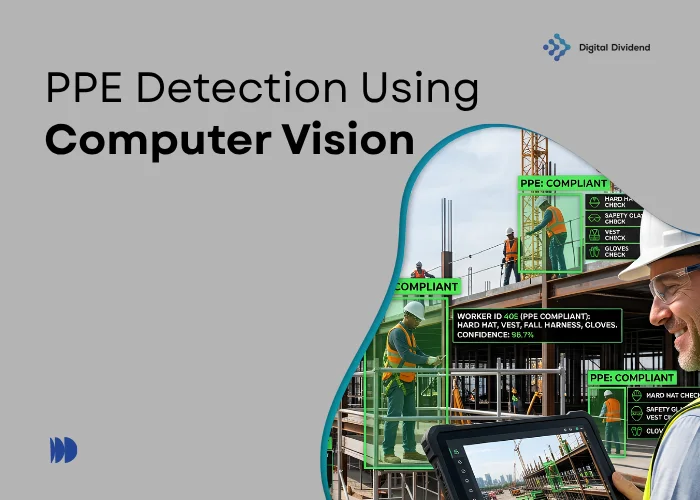
PPE detection using computer vision uses AI-powered cameras to automatically identify whether workers are wearing required safety gear hard hats, vests, gloves, and eye protection in real time. It flags violations instantly, replacing manual spot-checks with continuous, consistent monitoring across a worksite.
What Is PPE Detection Using Computer Vision?
PPE detection using computer vision exists to close that gap automatically. Visit Digital Dividend’s homepage to see how our team approaches AI engineering projects like this one.
What Is PPE (Personal Protective Equipment)?
PPE covers any equipment worn to reduce exposure to workplace hazards: hard hats, high-visibility vests, safety glasses, gloves, respirators, and fall-protection harnesses among them. Requirements vary by industry and by zone within a single site.
Why Traditional PPE Compliance Monitoring Falls Short
Manual monitoring relies on safety officers doing periodic walk-throughs, which means most of a shift goes unobserved. A worker can remove a hard hat the moment an inspector leaves and no one records it until an incident happens.
How Does Computer Vision Improve PPE Detection?
Building a working PPE detection using computer vision system means training a model to recognize specific safety equipment in a camera feed, then running that model continuously against live footage instead of a single inspection snapshot.
How AI and Deep Learning Power PPE Detection
Modern PPE detection relies on object-detection neural networks trained on thousands of labeled images showing workers correctly and incorrectly equipped. The model learns to recognize hard hats, vests, and gloves as distinct object classes, not just generic shapes. This is the same foundation our AI software development and data engineering teams build for any custom computer vision project, not PPE specifically.
Real-Time PPE Detection: How It Works
Once trained, the model runs against a live or near-live video stream, typically on edge hardware close to the camera to minimize lag, flagging a violation within seconds rather than at the next scheduled walk-through. Our AI agent development work covers this kind of continuous, monitored deployment a system that keeps running and improving, not a one-time install.
Traditional vs. AI-Powered PPE Detection Systems
The core tradeoff is coverage. A safety officer can be in one place at a time; cameras can watch every entry point and work zone simultaneously.
| Factor | Manual Monitoring | AI-Powered PPE Detection |
|---|---|---|
| Coverage | Periodic walk-throughs and spot checks | Continuous, every camera feed, every shift |
| Consistency | Depends on individual safety officer | Applies the same standard every time |
| Speed of alert | Delayed — reported after the fact | Near real-time flag on violation |
| Documentation | Manual logs, easy to miss entries | Automatic timestamped compliance records |
| Staffing need | Scales with headcount and site count | Scales with camera and compute, not headcount |
| Best fit | Small sites, low headcount | Large or multi-site industrial operations |
Key Benefits of PPE Detection Using Computer Vision
Reduced Risk of Human Error
A camera doesn’t get distracted, skip a section of the site, or make a judgment call under time pressure it applies the same detection criteria to every worker, every time.
Higher, More Consistent Safety Standards
Continuous monitoring closes the gap between scheduled inspections, catching violations that would otherwise go unnoticed for an entire shift.
Cost Savings and Operational Efficiency
Preventing a single serious incident often outweighs the cost of the monitoring system itself, before accounting for reduced insurance premiums and fewer lost workdays.
Better Access to Safety and Compliance Data
Every detection event gets logged automatically, building an audit trail that’s far more complete than manual paperwork. Our data and analytics services team can turn that log into a dashboard leadership actually uses, not just a compliance archive.
Industry Applications of AI-Powered PPE Detection
Manufacturing
Factory floors with moving machinery are exactly where the gap between required and worn PPE causes the most serious injuries.
Construction
Given that fall protection is OSHA’s most cited violation nationally, construction sites are the highest-leverage environment for camera-based compliance monitoring. Much of this depends on hardware and edge devices working together in real time the same territory our emerging technologies and IoT work covers, even outside a construction context.
Oil, Gas, and Mining
High-hazard environments where a single missed compliance check can have severe consequences benefit from continuous rather than periodic monitoring.
Warehouses and Logistics
Forklift traffic and heavy lifting make consistent high-visibility gear and footwear compliance a persistent, high-volume monitoring challenge.
How Digital Dividend Builds the AI Engineering Behind PPE Detection Systems
Digital Dividend isn’t a safety-camera hardware vendor. What we bring is the AI and IoT software engineering underneath systems like these: training data pipelines, model deployment, and the integration layer that connects cameras and sensors to the rest of a business’s software stack.
Our work on the Smart Ventilation System project involved a similar sensor-to-software pipeline real-time physical data processed and acted on automatically. Our CAN Bus Reading Tool and IoT Asset Tracking case studies follow the same pattern: physical-world data feeding a software layer that has to make decisions quickly and reliably.
As a software development agency with dedicated AI, data engineering, and IoT teams, Digital Dividend builds the custom software layer that turns camera and sensor data into decisions whether that’s a safety-compliance system, an asset tracker, or an internal monitoring dashboard.
Challenges of Implementing PPE Detection with Computer Vision
Accuracy in Real-World Conditions
Poor lighting, dust, motion blur, and workers partially obscured by equipment all reduce detection accuracy compared to a clean training dataset. Models need real-world footage from the actual site, not just stock imagery.
Employee Privacy Considerations
Continuous video monitoring raises legitimate employee-privacy questions. Clear policies on data retention, who can access footage, and what’s actually being logged matter as much as the detection accuracy itself.
Integration with Existing CCTV and Systems
Most worksites already have camera infrastructure; the question is whether a new detection layer can run against existing feeds or requires a hardware overhaul. Our enterprise application services team specializes in exactly this kind of integration with what a business already has in place.
How to Choose a PPE Detection Solution for Your Worksite
- Start with the zone or violation type that carries the highest injury risk, not the whole site at once.
- Check whether the solution can run against your existing CCTV or requires new hardware.
- Ask how the model was trained generic stock footage performs worse than site-specific data.
- Clarify data retention and privacy policy before rollout, not after.
If you’re weighing a custom-built approach against an off-the-shelf platform, our AI software development team can walk through the tradeoffs for your specific site.
Frequently Asked Questions
What is PPE detection using computer vision?
It’s the use of AI-powered cameras and object-detection models to automatically identify whether workers are wearing required safety equipment, flagging violations in real time instead of relying on periodic manual checks.
How accurate is PPE detection in industrial environments?
Accuracy depends heavily on training data quality and site conditions lighting, camera angle, and obstruction all affect performance, which is why site-specific training data outperforms generic datasets.
Will AI replace human safety officers?
No. Detection systems handle continuous monitoring and flagging; safety officers still investigate incidents, manage training, and make judgment calls the system isn’t designed to make.
Can PPE detection systems integrate with existing CCTV?
In many cases, yes the detection layer runs against existing video feeds rather than requiring entirely new camera hardware, though this depends on the existing system’s resolution and feed access.
What types of PPE can computer vision detect?
Common categories include hard hats, high-visibility vests, safety glasses, gloves, respirators, and fall-protection harnesses, though detection scope depends on how the model was trained.
Conclusion: Is PPE Detection Using Computer Vision Right for Your Worksite?
PPE detection using computer vision is fundamentally a software and data problem wearing a hardware hat: cameras capture the footage, but the value comes from the model training, real-time deployment, and system integration underneath. Whether you’re evaluating a purpose-built safety platform or considering a custom-built system, Digital Dividend can help you think through the AI engineering that makes it work.
Ready to talk through what a custom AI or IoT safety project could look like for your operation? Contact Digital Dividend for a free consultation.
