





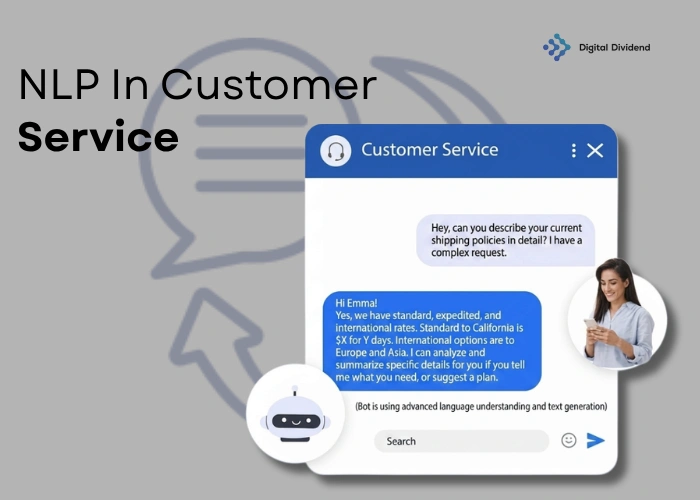
Natural language processing (NLP) in customer service uses AI to understand, interpret, and respond to customer language powering chatbots, sentiment analysis, and automated ticket routing. It helps support teams handle more conversations, faster, while surfacing customer intent human agents might miss.
What Is Natural Language Processing (NLP) in Customer Service?
Gartner’s own survey data puts the shift in context: 85% of customer service leaders planned to explore or pilot customer-facing generative AI in 2025, based on a survey of 187 service and support leaders (Gartner, December 2024). NLP in customer service is the technology underneath most of that shift the layer that lets software actually understand what a customer typed or said. Visit Digital Dividend’s homepage to see how our team approaches AI engineering projects like this one.
How NLP Differs from Traditional Customer Service Automation
Older automation relied on fixed keyword matching or rigid decision trees type the wrong phrase and the system breaks. NLP models are trained on real language patterns, so they can handle typos, slang, and phrasing variation while still identifying what the customer actually needs.
How NLP Works: Understanding, Sentiment, and Intent
Three layers typically work together: language understanding (parsing what was said), sentiment analysis (reading tone and urgency), and intent classification (routing to the right resolution path). Our AI software development team builds this same three-layer approach into any custom NLP system, not just customer service tools.
Key Use Cases of NLP in Customer Service
Chatbots and Virtual Assistants
The most visible NLP application: a chat or voice interface that resolves common requests without a human agent. Our generative AI development team builds these to actually reflect a business’s own knowledge base rather than a generic scripted flow.
Sentiment and Emotion Analysis
Flagging a frustrated or urgent message for priority handling, before an agent even opens the ticket, often prevents a bad interaction from becoming a lost customer.
Automated Ticket Routing and Classification
NLP can read an incoming ticket and route it to the right team or queue automatically, cutting the time a request sits unassigned. Our AI agent development work covers this kind of ongoing, monitored automation.
Voice Assistants and Call Center Analytics
Speech-to-text combined with NLP lets call centers transcribe, summarize, and analyze calls at scale surfacing patterns a manual review of call recordings never would. Our AI virtual assistant development work extends into exactly this kind of voice-driven interaction.
Multilingual and Cross-Language Support
Modern NLP models handle multiple languages without maintaining a separate rules engine for each one, which matters for any business supporting customers across regions.
Key Benefits of NLP in Customer Service
Faster Response Times and Higher Efficiency
Automating the first pass at understanding a request what it’s about, how urgent it is, where it should go cuts the time between a customer reaching out and getting a real answer.
Improved Customer Satisfaction Through Personalization
Understanding intent and context lets a system (or an agent, assisted by one) respond to what a customer actually needs rather than a generic script.
Lower Support Costs and Reduced Agent Workload
Handling routine, high-volume queries automatically frees agents to spend their time on the complex cases that genuinely need a person.
Challenges of Implementing NLP in Customer Service
Handling Complex or Nuanced Inquiries
NLP handles predictable, well-represented request types well. Ambiguous, multi-part, or highly unusual requests still tend to need a human in the loop.
Data Privacy and Security
Customer conversations often include sensitive information, which means any NLP system needs the same data-handling discipline as the rest of a company’s customer data infrastructure.
Bias, Fairness, and Accuracy
Models trained on unrepresentative data can perform worse for some customer segments than others a gap that needs active monitoring, not a one-time check at launch.
Integration with Existing Systems
An NLP layer is only useful if it connects cleanly to the CRM, ticketing system, and knowledge base already in place. Our data engineering and enterprise application teams handle this kind of integration work regularly.
NLP in Customer Service by Industry
Banking and Financial Services
Fraud-alert triage, account inquiries, and compliance-sensitive conversations make banking one of the highest-stakes environments for accurate, auditable NLP.
Retail and Ecommerce
Order status, returns, and product questions are exactly the high-volume, repetitive request types NLP handles most reliably.
Healthcare
Appointment scheduling, insurance questions, and basic triage benefit from NLP, though healthcare’s compliance requirements demand a more careful build. Our healthcare software development team works inside exactly this kind of compliance-heavy environment.
Traditional Automation vs. NLP-Powered Support
| Factor | Traditional Automation | NLP-Powered Support |
|---|---|---|
| How it matches queries | Fixed keywords or menu trees | Understands intent and phrasing variation |
| Handles typos/slang | Poorly breaks the match | Generally well trained on real language |
| Sentiment awareness | None | Detects tone and urgency |
| Setup effort | Simpler, rule-based | Higher upfront, more flexible long-term |
| Best fit | Narrow, predictable queries | Varied, conversational support volume |
How Digital Dividend Builds NLP-Powered Customer Service Tools
Digital Dividend builds custom NLP and AI systems for support teams, not off-the-shelf chatbot widgets. Our SupportSync AI case study walks through a full AI-powered customer support platform build the same kind of intent understanding, routing, and sentiment analysis covered in this guide, applied to a real product.
As a software development agency with dedicated AI and generative AI teams, Digital Dividend builds NLP tools around a business’s actual support workflow and knowledge base, not a generic template.
The Future of NLP in Customer Service
The trend is toward assisted, not replaced, human agents. A June 2025 Gartner poll of 163 customer service leaders found 95% plan to retain human agents and use AI to strategically support their role, rather than eliminate it and Gartner separately predicts that by 2027, half of organizations that planned significant workforce reductions will abandon those plans. The realistic near-term future is AI handling the first pass on volume, with people handling everything that needs judgment.
Frequently Asked Questions
What is natural language processing in customer service?
NLP in customer service refers to AI systems that understand, interpret, and respond to customer language powering chatbots, sentiment analysis, ticket routing, and voice assistants.
How does NLP improve customer service?
It speeds up response times, routes requests more accurately, and surfaces customer sentiment and intent that would otherwise require a human to read every message manually.
Can NLP chatbots fully replace human agents?
Generally no. Gartner’s own 2025 survey data found 95% of customer service leaders plan to retain human agents and use AI to support rather than eliminate their role.
What are the limitations of NLP in customer support?
NLP handles predictable, well-represented request types well but tends to struggle with ambiguous, highly unusual, or emotionally complex conversations that still benefit from a human agent.
Is NLP the same as machine learning in customer service?
No. Machine learning is the broader technique used to train models; NLP is the specific application of that technique to understanding and generating human language.
What industries use NLP in customer service?
Banking, retail, ecommerce, healthcare, travel, and telecommunications are among the most common adopters, though the underlying technology applies to nearly any support-heavy business.
Conclusion: Is NLP Right for Your Customer Service Strategy?
NLP in customer service isn’t about replacing your support team it’s about giving them a system that understands customers as well as they do, at a scale no team could match manually. Digital Dividend builds the custom AI engineering underneath tools like these, fitted to your actual support workflow.
Ready to talk through what an NLP-powered support tool could look like for your team? Contact Digital Dividend for a free consultation.
