





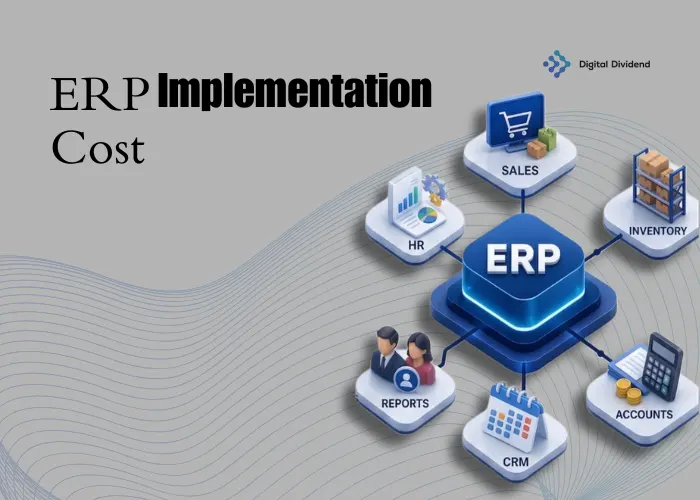
ERP implementation cost ranges from $25,000 for small businesses to over $5 million for large enterprises. The total depends on deployment model, number of users, level of customization, and the ERP vendor chosen. Most mid-market companies budget between $150,000 and $500,000 for a full implementation.
Choosing an ERP system is one of the most significant technology investments a business will make. But before you commit, you need a clear, honest answer to one question: what does ERP implementation actually cost?
The answer is rarely simple. ERP implementation cost varies widely depending on your business size, the platform you choose, how much customization you need, and whether you deploy in the cloud or on-premise. This guide cuts through the noise and gives you real figures, honest breakdowns, and a framework to budget with confidence.
At Digital Dividend, we work with startups, SMBs, and enterprises on ERP strategy, implementation, and customization. Everything in this guide reflects what businesses actually pay not vendor marketing estimates.
What Is the Cost of Implementing an ERP System?
ERP implementation cost is the total financial investment required to select, configure, deploy, and go live with an enterprise resource planning system. It covers far more than just the software licence fee and that distinction matters enormously when building your budget.
What Does ERP Implementation Cost Include?
A complete ERP implementation budget spans six major cost areas:
- Software Licensing: The recurring or one-time fee paid to the ERP vendor for access to the platform.
- Infrastructure: Server hardware, cloud hosting, and network requirements to run the system.
Implementation Services: Consulting, configuration, project management, and go-live support fees. - Data Migration: The cost of cleaning, mapping, and transferring legacy data into the new system.
- Customization: Development work required to adapt the ERP to your specific business processes.
- Training: End-user and administrator training to ensure adoption across the organization.
Most businesses underestimate implementation services and data migration these two categories alone can account for 30–50% of the total project budget (Gartner, 2024).
ERP Implementation Cost vs Total Cost of Ownership
ERP implementation cost covers the initial project from kickoff to go-live. Total Cost of Ownership (TCO) includes everything you will pay over the system’s lifetime: annual licences, support contracts, upgrades, additional customization, and internal IT resources.
For a 5-year horizon, TCO typically runs 2–3x the initial implementation cost. A $200,000 implementation may carry a 5-year TCO of $400,000–$600,000. Understanding TCO is essential for accurate financial planning and board-level budget approval.
Is ERP Implementation Cost Upfront or Ongoing?
Both. Implementation costs are primarily upfront consulting fees, configuration, data migration, and training are charged during the project phase. However, significant ongoing costs begin at go-live: annual software subscriptions, maintenance, support contracts, and periodic upgrades.
Cloud ERP systems shift more cost to the ongoing side (lower upfront, higher annual fees). On-premise deployments front-load the investment but may carry lower long-term subscription costs.
ERP Implementation Cost Breakdown
Here is a detailed breakdown of the individual cost components that make up a typical ERP implementation budget:
Cost Component | Typical Range (USD) |
Software Licensing | $5,000 – $250,000+/year |
Infrastructure / Hosting | $2,000 – $50,000+ |
Implementation & Consulting | $20,000 – $500,000+ |
Data Migration | $5,000 – $50,000 |
Customization & Development | $10,000 – $200,000+ |
Training | $5,000 – $30,000 |
Ongoing Support & Maintenance | $5,000 – $75,000/year |
Hidden / Unplanned Costs | $10,000 – $100,000+ |
Software Licensing Costs: Perpetual vs Subscription
ERP vendors offer two primary licensing structures:
- Perpetual Licensing: A one-time fee to own the software indefinitely, plus annual maintenance (typically 15–20% of the licence cost). Common in on-premise deployments. Upfront cost is high but long-term cost can be lower.
- Subscription Licensing: A recurring monthly or annual fee per user or per module. Common in cloud deployments. Lower upfront cost but continuous payment obligation.
For most SMBs, subscription-based cloud ERP offers better cash flow management.Enterprises with strict data control requirements often prefer perpetual licences on-premise.
Infrastructure and ERP Setup Costs
Cloud ERP eliminates most infrastructure cost the vendor manages servers, backups, and uptime. On-premise deployments require significant hardware investment: servers, storage, networking equipment, and ongoing IT staff to manage them. Budget $10,000–$100,000+ for on-premise infrastructure depending on scale.
Personnel and Internal Resource Costs
Internal resource costs are frequently omitted from ERP budgets — and frequently cause overruns. Your team will spend significant time on requirements gathering, UAT testing, data preparation, and training. For a mid-market implementation, expect 500–2,000 hours of internal resource time, which carries a real cost even if not directly invoiced.
ERP Integration Expenses
Most businesses run ERP alongside existing systems — CRM, ecommerce platforms, payroll, industry-specific tools. Integrating these systems adds cost. Simple integrations run $5,000–$20,000; complex bi-directional integrations with legacy systems can reach $100,000+.
Digital Dividend’s ERP software development services include custom integration work to connect your ERP with existing business systems without data loss or workflow disruption.
Hidden Costs in ERP Deployment
The most common budget-busters in ERP projects include:
- Data quality remediation — dirty data discovered during migration that requires manual cleaning before import.
- Scope creep — feature requests added mid-project that extend timelines and consulting fees.
- Change management — the organizational cost of getting people to actually use the system.
- Parallel running — operating the old and new systems simultaneously during transition.
- Post-go-live fixes — bugs, configuration corrections, and workflow adjustments after launch.
Build a contingency of 15–20% into your ERP budget specifically for hidden and unplanned costs.
Ongoing ERP Costs After Implementation
Once live, your ERP incurs recurring annual costs including software subscription or maintenance fees (15–22% of licence value), hosting or infrastructure costs, support contracts, periodic version upgrades, and ongoing training for new staff. For most mid-market businesses, plan for $25,000–$100,000 per year in ongoing ERP costs.
ERP Implementation Cost Factors: What Drives the Price
No two ERP implementations cost the same. The following factors have the most significant impact on where your project lands on the cost spectrum:
Deployment Choice: Cloud ERP vs On-Premise ERP Implementation Cost
Deployment model is the single biggest driver of upfront cost. Cloud ERP (SaaS) implementations typically cost 30–50% less upfront than equivalent on-premise deployments because infrastructure, maintenance, and upgrades are absorbed by the vendor. On-premise deployments carry higher initial investment but can offer lower long-term licensing costs and greater control over data.
ERP Implementation Cost Per User
User count directly impacts licensing cost. Most cloud ERP platforms charge per named user per month ranging from $20–$300+ per user depending on the platform and module access required. A 50-user implementation at $100/user/month adds $60,000 per year in licensing alone. Named user vs concurrent user licensing models can significantly change your cost always clarify which model applies.
Customization and Module Costs
Standard ERP configuration is always cheaper than custom development. Every customization adds implementation time, testing effort, and long-term maintenance cost. Avoid customization where a standard workflow can be adapted to fit. When customization is unavoidable, document it rigorously undocumented customizations become the most expensive part of any future upgrade.
Digital Dividend’s expert developers offer Odoo development services and ERPNext services for businesses that need platform-specific customization with full documentation and upgrade pathways.
Business Size and Complexity
More users, more data, more integrations, more locations, and more complex business processes all drive cost upward. A single-site 20-user implementation is categorically different from a multi-country 500-user rollout. Complexity is the most underestimated cost factor in ERP projects.
How Do ERP Implementation Costs Vary by Industry?
Industry vertical significantly affects ERP cost due to compliance requirements, regulatory frameworks, and process complexity:
ERP Implementation Cost for Manufacturing Companies
Manufacturing ERP implementations are among the most complex requiring MRP, production scheduling, quality control, shop floor management, and supply chain modules. Expect $150,000–$1,000,000+ depending on scale, with multi-site manufacturers at the higher end.
ERP Implementation Cost for Service-Based Businesses
Service businesses typically require fewer modules than manufacturers, reducing implementation complexity. Professional services ERP implementations commonly range from $50,000–$300,000, with project management, billing, and resource planning as core modules.
ERP Implementation Cost by Business Size
Business Size | Typical ERP Implementation Cost |
Small Business (< $10M revenue) | $25,000 – $150,000 |
Mid-Market ($10M – $50M revenue) | $150,000 – $500,000 |
Large Enterprise ($50M+ revenue) | $500,000 – $5,000,000+ |
ERP Implementation Cost for Small Businesses
Small businesses (under $10M revenue, typically 10–50 users) should budget $25,000–$150,000 for a full ERP implementation. Cloud-based platforms like Odoo Community Edition or ERPNext offer open-source options that dramatically reduce licensing cost, with implementation and customization as the primary expense. Key priorities at this tier: speed to value, minimal customization, and a system that grows with the business.
ERP Implementation Cost for Medium-Sized Businesses
Mid-market companies ($10M–$50M revenue, 50–250 users) typically spend $150,000–$500,000. At this tier, integration complexity increases significantly connecting ERP to existing CRM, ecommerce, and warehousing systems adds substantial cost. A phased implementation approach, starting with core financials and expanding, helps manage budget and risk.
ERP Implementation Cost for Large Enterprises
Enterprise implementations ($50M+ revenue, 250+ users, multi-site or multi-country) routinely exceed $500,000 and can reach $5,000,000+ for Tier 1 platforms like SAP S/4HANA or Oracle. Change management, data governance, and global rollout coordination drive cost at this tier as much as the technology itself.
Comparing ERP Pricing Models
Pricing Model | How It Works | Best For |
User-Based | Fixed fee per named or concurrent user per month | SMBs with predictable user counts |
Module-Based | Pay per functional module activated | Companies needing selective rollout |
Resource / Usage-Based | Billed on transactions, data volume, or API calls | High-volume, variable workloads |
Custom / Fixed-Price | Negotiated flat fee for defined project scope | Enterprise with complex requirements |
User-Based ERP Implementation Pricing
User-based pricing is the most common model for cloud ERP platforms. You pay a fixed fee per user per month typically $20–$300 depending on the platform and role. Finance users may carry a higher per-seat cost than warehouse staff on limited-access licences. This model is predictable and scales cleanly but can become expensive as headcount grows.
Module-Based ERP Software Pricing
Module-based pricing lets businesses activate only the functional areas they need financials, inventory, HR, manufacturing, CRM and pay accordingly. This keeps costs lower in early phases and allows expansion as the business grows. The risk: integration between selectively activated modules can create gaps if not carefully planned.
Resource and Usage-Based ERP Pricing
Some platforms charge based on transaction volume, data storage, or API call volume rather than user count. This model suits high-volume, operationally intensive businesses where user count is low but system activity is high distribution, logistics, or ecommerce fulfillment operations.
Custom ERP Implementation Pricing
For enterprises with highly specific requirements, fixed-price custom implementation contracts are negotiated directly with vendors or implementation partners. These offer cost certainty but require extremely detailed scope documentation upfront. Any scope change post-contract typically triggers a change order a major source of cost overruns in large ERP projects.
What Are the Differences in ERP Implementation Costs Across Vendors?
Vendor choice is arguably the most consequential cost decision in the entire ERP process. Tier 1 platforms (SAP, Oracle) carry implementation costs 5–10x higher than Tier 2 (NetSuite, Dynamics 365) or Tier 3 (Odoo, ERPNext) alternatives. Choosing the right tier for your business size and complexity is a critical strategic decision not just a budget one.
Comparing Costs of ERP Deployment Models
Deployment Model | Upfront Cost | Ongoing Cost | Best For |
Cloud (SaaS) | Low ($0 – $20K) | $10K – $100K/year | SMBs and fast-growing companies |
On-Premise | High ($100K – $500K+) | $20K – $80K/year | Enterprises with strict data control |
Hybrid | Medium ($50K – $200K) | $15K – $120K/year | Mid-market with mixed requirements |
Cost of Implementing Cloud ERP
Cloud ERP (SaaS) is now the default choice for most SMBs and a growing number of mid-market companies. Implementation costs are lower because infrastructure is managed by the vendor, upgrades are automatic, and go-live timelines are typically shorter. Annual subscription costs run $10,000–$100,000+ depending on user count and modules. The trade-off: less control over data location and customization constraints.
On-Premise ERP Implementation Cost
On-premise implementations carry the highest upfront cost hardware, server licensing, installation, and configuration all occur before the first user logs in. Total implementation budgets routinely start at $100,000 for small deployments and scale to $1,000,000+ for complex enterprise rollouts. However, long-term costs can be lower when amortized over 7–10 years with stable user counts.
Hybrid ERP Deployment Cost Considerations
Hybrid deployments combine cloud-hosted ERP with on-premise integrations for specific functions often used when sensitive data must remain on local servers for regulatory reasons. They carry implementation complexity from both deployment models and typically land in the $50,000–$300,000 range for mid-market businesses. Careful architecture planning at the outset is essential to avoid expensive rework.
ERP Implementation Cost Analysis: Top ERP Platforms
ERP Platform | Implementation Cost Range | Pricing Model | Best For |
Odoo | $10,000 – $150,000 | Subscription + user-based | SMBs, startups, mid-market |
NetSuite | $75,000 – $300,000+ | Annual subscription + modules | Mid-market to enterprise |
SAP S/4HANA | $300,000 – $3,000,000+ | License + subscription | Large enterprises |
MS Dynamics 365 BC | $50,000 – $250,000 | Per-user subscription | SMB to mid-market |
Odoo ERP Implementation Cost
Digital Dividend’s professional developers specialize in Odoo development and customization — helping businesses configure, extend, and integrate Odoo without unnecessary cost or timeline overruns.
Odoo is one of the most cost-effective ERP platforms for SMBs and mid-market businesses. The Community Edition is open-source and free — implementation and customization fees are the primary cost. Enterprise Edition subscription runs approximately $20–$40 per user per month. Total implementation cost typically falls between $10,000 and $150,000 depending on scope and customization level.
NetSuite ERP Pricing
NetSuite targets mid-market and enterprise businesses with a comprehensive cloud ERP suite. Licensing typically starts at $1,000–$2,000 per month for base access, plus per-user fees of $100–$150/user/month. Implementation costs range from $75,000 to $300,000+ depending on module count and customization. NetSuite’s annual contract model provides pricing predictability but limits negotiating flexibility.
SAP S/4HANA Implementation Cost
SAP S/4HANA is a Tier 1 enterprise platform with correspondingly Tier 1 implementation costs. Expect $300,000 at the absolute minimum for a limited-scope deployment, with most enterprise implementations running $1,000,000–$3,000,000+. Implementation partner fees often exceed the software licence cost itself. SAP is appropriate for large, complex global enterprises — it is categorically not cost-effective for SMBs.
Microsoft Dynamics 365 Business Central Pricing
Dynamics 365 Business Central targets SMBs and lower mid-market businesses with per-user pricing starting at $70–$100/user/month for Essentials tier and $100–$130/user/month for Premium tier. Implementation costs typically range from $50,000 to $250,000. Microsoft’s ecosystem integration (Office 365, Teams, Azure) adds genuine value for businesses already on Microsoft infrastructure.
How Much Does ERP Implementation Impact ROI?
Benefit Area | Typical Impact |
Inventory Cost Reduction | 15% – 30% reduction in carrying costs |
Operational Efficiency | 20% – 40% reduction in manual processing time |
Reporting Speed | Up to 80% faster financial close cycles |
Error Reduction | 50% – 70% reduction in data entry errors |
Revenue Visibility | Real-time pipeline and forecasting accuracy improved significantly |
Is ERP Implementation Worth the Cost?
For most businesses operating above $5M in revenue with growing operational complexity, the answer is yes but only with proper implementation. An ERP that is poorly implemented, under-adopted, or over-customized destroys ROI. A well-implemented ERP with strong change management and user adoption delivers measurable returns within 18–36 months in most cases.
The risk is not the technology it is the implementation. Choosing the right implementation partner is as important as choosing the right platform.
What Are the Total Expenses for ERP Integration vs Business Returns?
A $200,000 mid-market ERP implementation that improves inventory accuracy, reduces manual processing, and accelerates financial reporting can return its cost multiple times within three years. The key is measuring the right KPIs before go-live inventory carrying costs, order processing time, financial close cycle, and error rates so ROI can be demonstrated objectively post-implementation.
How Does ERP Implementation Cost Compare to Other Software Investments?
ERP is significantly more expensive than point solutions (CRM, accounting software, inventory tools) because it integrates and replaces many of them. The comparison is not ERP vs one tool it is ERP vs the combined cost and inefficiency of running 5–10 disconnected systems. When framed correctly, ERP implementation cost is often the more economical choice at scale.
How Can Companies Reduce ERP Implementation Costs?
Proven Approaches to Reducing ERP Rollout Cost
- Choose the right tier — Odoo or ERPNext for SMBs; NetSuite or Dynamics for mid-market; SAP or Oracle only for large enterprises. Over-buying platform is the single most common source of budget overrun.
- Minimize customization — configure standard workflows to fit your processes before writing a single line of custom code.
- Clean your data before migration — every hour spent on data quality before migration saves ten hours during it.
- Implement in phases — core financials first, then operational modules, then advanced features. Phased rollout reduces risk and spreads cost.
- Invest in change management — user adoption failure is the leading cause of ERP projects that never deliver ROI.
- Fix internal resource allocation — assign a dedicated internal project owner with authority to make decisions. Lack of internal ownership causes delays that cost money.
How to Negotiate ERP Pricing Effectively
ERP vendors discount often significantly. End-of-quarter and end-of-year are the best times to negotiate. Always get competing quotes, even if you have a preferred vendor. Negotiate implementation fees separately from licensing some vendors bundle these to obscure the true cost breakdown. Push for fixed-price implementation contracts with defined deliverables rather than time-and-materials, which carry unlimited upside risk.
Are There Financing Options for ERP Implementation Costs?
Yes. Most major ERP vendors offer payment plans or multi-year subscription structures that spread upfront implementation cost. Some implementation partners offer deferred payment arrangements. For small businesses, SaaS-based ERP with monthly billing is effectively a financing structure eliminating large capital expenditure in exchange for predictable operating expense.
What Is the Average Cost for ERP Implementation in the US?
Based on 2024–2025 market data, the average ERP implementation cost in the United States is approximately $175,000 for mid-market businesses when including software, services, data migration, and training. Small business implementations average $50,000–$80,000. Enterprise implementations average $750,000–$2,000,000. These are project costs only ongoing annual costs are additional (Panorama Consulting, 2024).
Frequently Asked Questions About ERP Implementation Cost
What Is the Cost of Implementing an ERP System?
ERP implementation cost ranges from $25,000 for small businesses using open-source platforms like Odoo or ERPNext, to over $5,000,000 for large enterprise deployments on SAP S/4HANA or Oracle. Most mid-market implementations fall between $150,000 and $500,000.
What Factors Affect ERP Implementation Cost?
The primary cost drivers are: business size and user count, deployment model (cloud vs on-premise), level of customization required, number of integrations with existing systems, ERP vendor and tier chosen, and the experience level of the implementation partner.
How to Estimate ERP Implementation Expenses?
Start with your user count and multiply by the per-user licensing cost. Add implementation services (typically 1–3x the annual licence cost). Add data migration (10–20% of implementation services). Add training (5–10% of total). Add a 15–20% contingency. This bottom-up model gives you a working budget range before any vendor conversation.
What Are the Typical Costs Associated with ERP Systems?
Typical ERP costs include: software licensing ($5,000–$250,000+/year), implementation and consulting ($20,000–$500,000), data migration ($5,000–$50,000), customization ($10,000–$200,000+), training ($5,000–$30,000), and ongoing support ($5,000–$75,000/year).
What Are the Ongoing Costs After ERP Implementation?
After go-live, plan for annual software maintenance or subscription fees (15–22% of licence value for perpetual; full subscription for SaaS), support contracts, periodic upgrades, and ongoing training for new staff. For most mid-market businesses, budget $25,000–$100,000 per year in ongoing ERP costs.
ERP Implementation Cost for Small Businesses: What to Expect?
Small businesses should expect to spend $25,000–$150,000 for a complete ERP implementation. Cloud-based platforms like Odoo reduce licensing cost significantly. The largest cost component at this tier is typically implementation consulting and configuration, not software.
How Is ERP Implementation Cost Calculated?
ERP implementation cost is calculated by summing all project components: software licensing, infrastructure, implementation services, data migration, customization development, training, and contingency. Getting itemized quotes from vendors and implementation partners — rather than a single bundled price — is essential for understanding where your money goes.
Conclusion: Plan Your ERP Implementation Cost with Confidence — Digital Dividend
ERP implementation is a significant investment — but it is a manageable one when you approach it with accurate information, the right platform choice, and a partner who prioritizes your outcome over their billable hours.
The businesses that overspend on ERP do so because they chose the wrong tier, underestimated customization, neglected data migration, or skipped change management. None of these are unavoidable mistakes.
Digital Dividend is a software development agency specializing in ERP implementation, customization, and integration for startups, SMBs, and enterprises. Our experienced developers have delivered Odoo, ERPNext, and custom ERP solutions across manufacturing, healthcare, distribution, and professional services.
