





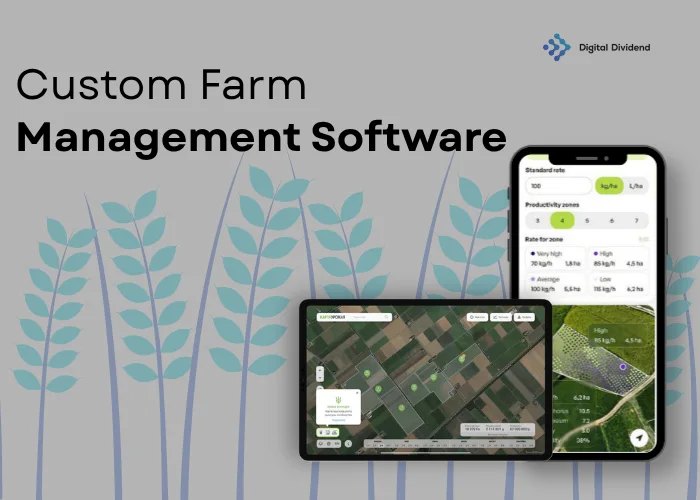
Custom farm management software is a platform built specifically for one operation’s crops, livestock, equipment, and reporting needs, instead of the generic feature set in off-the-shelf tools. It costs more upfront than a subscription, but fits complex or mixed operations where standard software forces workarounds.
What Is Farm Management Software?
Farm management software covers a wide range of tools: crop planning, livestock tracking, equipment scheduling, and financial reporting, all meant to replace paper records and spreadsheets. Recent USDA Economic Research Service data shows adoption climbing sharply with farm size autosteering systems are used by 70% of large-scale crop-producing farms versus far lower rates on small operations, largely because bigger, more complex operations outgrow what generic tools can handle. Visit Digital Dividend’s homepage to see how our team approaches custom software projects like this one.
How Farm Management Software Works
Most platforms center on a few core functions: tracking inputs and outputs by field or herd, logging labor and equipment hours, and rolling that data up into cost-of-production and profitability reports.
Farm Management Software vs. ERP: What's the Difference?
Farm management tools are usually purpose-built for agricultural workflows crop cycles, herd health, field boundaries. ERP systems are broader, covering finance, inventory, and operations across an entire business. For larger or diversified agribusinesses, the real question often isn’t “which farm app” but whether farm operations should live inside a broader ERP platform instead of a standalone tool.
Off-the-Shelf Software: What It Solves (and Where It Falls Short)
Where Off-the-Shelf Tools Work Well
For a single-enterprise operation with standard crop or livestock needs, an off-the-shelf subscription gets you running in days, with a support team and existing integrations already built.
Where Off-the-Shelf Tools Hit Limits
Off-the-shelf tools are built for the average customer, not your specific operation. Mixed crop-and-livestock operations, unusual compliance requirements, or a need to integrate with existing ERP or IoT systems often mean working around the software instead of the other way around.
When Custom Farm Management Software Makes Sense
Multi-Enterprise or Mixed Operations
Operations running crops, livestock, and processing under one roof often find that no single off-the-shelf tool covers all three well, forcing them to stitch together multiple subscriptions instead of one system.
Integration with Existing Equipment, ERP, or IoT Sensors
GPS-guided equipment, soil sensors, and livestock wearables generate data that’s only useful if it flows into the same system as your financial and operational records. Our IoT and connected device work is built around exactly this kind of sensor-to-software integration.
Unique Compliance or Traceability Requirements
Organic certification, export traceability, or region-specific reporting requirements sometimes exceed what a generic platform’s compliance module was built to handle.
Build vs. Buy: A Practical Comparison
| Factor | Off-the-Shelf Software | Custom-Built Software |
|---|---|---|
| Time to launch | Fast sign up and go | Longer weeks to months |
| Fit to operation | Generic, built for the average farm | Built around your specific crops, livestock, and workflow |
| Multi-enterprise support | Often limited or bolted-on | Built to handle mixed operations natively |
| Equipment & ERP integration | Limited to vendor’s supported connectors | Built to connect to your specific equipment and systems |
| Ongoing cost | Recurring per-user or per-acre fees | One-time build, lower long-term cost at scale |
| Best fit | Small, single-enterprise operations | Large, mixed, or highly specialized operations |
Key Capabilities to Plan For in a Custom Platform
Crop and Livestock Data Tracking
Field-level and herd-level records need to be structured for how your operation actually works, not forced into generic categories a vendor chose for a different kind of farm.
IoT and Equipment Integration
GPS auto-steer, yield monitors, and livestock wearables should feed directly into your platform rather than sitting in a separate vendor dashboard nobody checks. Our mobile app development team builds the field-level access this typically requires.
Financial and Cost-of-Production Reporting
Profitability by field, by herd, or by enterprise is the metric that actually drives decisions. Our data and analytics services and Power BI work turn raw operational data into the reporting leadership actually uses.
Compliance and Traceability
Automated, timestamped records make audits and certifications far less painful than reconstructing a season from paper logs after the fact.
How Digital Dividend Builds Custom Operations Software
Digital Dividend isn’t a farm software vendor. What we bring is the custom software engineering underneath systems like these: ERP-grade data structures, IoT integration, and reporting built around how a specific business actually operates rather than a generic template.
Our BuildCore ERPNext manufacturing case study shows exactly this kind of custom ERP build for an operations-heavy business. Our IoT Asset Tracking and M2M Telecommunications case studies cover the equipment and sensor integration side the same pattern that applies to GPS-guided farm equipment or livestock wearables.
As a software development agency with dedicated ERP, IoT, and data engineering teams, Digital Dividend builds the software layer that fits a specific operation instead of forcing that operation to adapt to someone else’s product roadmap.
What Does Custom Farm Management Software Cost to Build?
Cost depends on scope: a focused tool covering one workflow (say, cost-of-production reporting for a single enterprise) costs far less than a full platform spanning crops, livestock, equipment, and finance. Most operations are better served starting with a narrow pilot covering the highest-friction workflow, then expanding once that piece is proven.
How to Get Started
- Identify the one workflow where off-the-shelf software creates the most friction or workarounds today.
- Map what data you already have spreadsheets, equipment logs, existing subscriptions.
- Decide whether farm operations should live inside a broader ERP system or as a standalone platform.
- Scope a pilot on that one workflow before planning a full build.
If you’re weighing whether a custom build makes sense for your operation, our consultation and guidance team can walk through the tradeoffs with you.
Frequently Asked Questions
What is the difference between farm management software and ERP?
Farm management software is typically purpose-built for agricultural workflows like crop cycles and herd tracking, while ERP systems cover a broader range of business functions including finance, inventory, and operations across an entire company.
How does farm management software work?
It centralizes records for inputs, outputs, labor, and equipment by field or herd, then rolls that data into cost-of-production and profitability reporting.
What types of farms benefit from custom software?
Mixed or multi-enterprise operations, larger operations with complex equipment integration needs, and businesses with unique compliance or traceability requirements tend to outgrow generic off-the-shelf tools first.
Is custom farm management software suitable for organic farms?
Yes in fact, organic certification and traceability requirements are one of the more common reasons operations move away from generic platforms toward a custom-built compliance workflow.
How secure is custom farm management software?
Security depends entirely on how the system is architected. A custom build lets you design data access, backups, and compliance requirements around your specific needs rather than accepting a vendor’s default configuration.
Conclusion: Finding the Right Approach for Your Operation
Off-the-shelf farm management software is the right call for straightforward, single-enterprise operations. But as USDA data on precision agriculture adoption shows, the more complex and larger an operation gets, the more it tends to outgrow generic tools. Digital Dividend builds the custom software layer for operations that have reached that point.
Ready to talk through whether a custom build makes sense for your operation? Contact Digital Dividend for a free consultation.
