





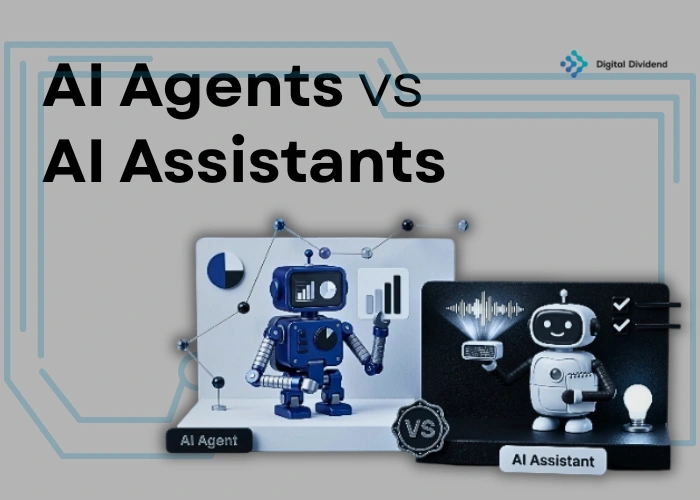
Quick Answer: AI Assistants handle user-driven tasks like scheduling and answering queries. AI Agents run independently managing multi-step workflows and acting on data without waiting for human direction. Choosing between them depends on your business complexity, automation needs, and how much human oversight your processes require.
AI is reshaping business operations but the tools driving that change work very differently from one another. AI Assistants help users with tasks like scheduling, answering queries, and managing emails, with 72% of consumers using them for customer service (PwC, 2023). AI Agents, on the other hand, work independently. A 2023 Gartner report found that over 40% of large enterprises had already deployed some form of autonomous AI Agent to automate operational tasks.
At Digital Dividend, our expert developers work with both types of AI helping startups, healthcare businesses, and enterprises implement the right solution. Whether you need a responsive assistant or a fully autonomous system, getting this distinction right will save you time, money, and integration headaches.
Understanding AI Assistants
AI Assistants have redefined how people get things done turning time-consuming routines into quick, automated actions. They receive your input and act on it, managing calendars, surfacing answers, and keeping you on track in real time. Their core strength remains user interaction.
Advancements in natural language processing (NLP) are pushing them toward more complex roles, but the gap between Assistants and Agents remains significant for most enterprise use cases.
What Are AI Assistants?
AI Assistants are intelligent software tools that interpret and respond to human language to carry out tasks on your behalf. They help organize schedules, set reminders, and answer questions. Common examples include Siri, Alexa, and Google Assistant.
How AI Assistants Work
AI Assistants process your text or voice input using machine learning and NLP, then execute the appropriate action. They may access connected databases like calendars or rely on cloud systems for more complex responses.
Key Features of AI Assistants
- Natural Language Understanding: Interprets human language to identify intent and respond accurately.
- Task Automation: Handles routine actions like reminders, updates, and scheduling without manual effort.
- Voice Interaction: Enables hands-free, conversational use across devices.
- Context Awareness: Retains prior interaction history to deliver personalized responses over time.
AI Assistant Limitations
AI Assistants struggle when queries become complex or context-dependent. They rely on predefined data sets and typically need a live internet connection which limits their flexibility in offline or high-complexity environments.
Can AI Assistants Become Agents?
The line between Assistants and Agents is narrowing fast. With improvements in autonomous decision-making and cross-platform integration, some modern tools now combine characteristics of both. Learn more about how Digital Dividend’s AI software development services help businesses implement these converging systems.
Understanding AI Agents
AI Agents operate on their own executing tasks, making decisions, and adapting to new information without needing you to initiate each step. They work from goals and real-time data, not commands.
Their role is expanding rapidly across finance, logistics, and healthcare anywhere that speed, scale, and autonomous decision-making deliver a measurable edge.
What Are AI Agents?
AI Agents are autonomous software systems that handle tasks, make decisions, and interact with their environment based on predefined goals without human intervention at each step. They operate across contexts ranging from supply chain management to intelligent process automation.
How AI Agents Work
AI Agents process live data through intelligent algorithms continuously adjusting their actions to achieve defined goals. In logistics, for example, an AI Agent reacts to real-time delays, rerouting deliveries automatically without waiting for a human decision.
Key Features of AI Agents
- Autonomy: Operate and make decisions without requiring step-by-step human oversight.
- Goal-Oriented: Designed to pursue specific, measurable objectives end-to-end.
- Adaptability: Adjust actions dynamically based on incoming data and changing conditions.
- System Integration: Connect across platforms and tools to gather data and execute tasks at scale.
AI Agent Limitations
AI Agents are only as reliable as the data they run on. Flawed or biased inputs produce flawed outputs. They also lack human intuition making them unsuitable for tasks that require emotional judgment, ethical nuance, or contextual sensitivity.
Can AI Agents Replace AI Assistants?
No. Greater autonomy doesn’t make AI Agents a substitute for Assistants they serve fundamentally different purposes. Assistants handle user-facing interaction; Agents manage backend complexity. Most mature AI ecosystems rely on both working in tandem. Explore our services to see how Digital Dividend approaches this in client projects.
AI Assistants vs. AI Agents: Side-by-Side Comparison
Getting this distinction right can determine whether your AI investment delivers real operational value or just adds complexity. Assistants are reactive built for interaction. Agents are proactive built for outcomes.
Feature Comparison
| Feature | AI Assistants | AI Agents |
|---|---|---|
| Functionality | Task-oriented, user interaction | Autonomous, decision-making |
| Key Use Cases | Scheduling, answering queries | Process automation, complex tasks |
| Complexity | Simple, repetitive tasks | Multi-step decision-making |
| Automation Level | Low (user-driven) | High (system-driven) |
| Industry Use | Customer service, productivity | Finance, logistics, healthcare |
How Do AI Agents Enhance Productivity Compared to Assistants?
AI Agents drive productivity by removing humans from repetitive decision loops entirely. Organizations deploying AI Agents in logistics and customer service reported a 40% productivity increase, according to Accenture (2023). AI Assistants, while genuinely useful, are capped by their reactive design they cannot drive complex workflows end-to-end.
Digital Dividend’s experienced developers with AI have helped clients achieve similar gains as demonstrated in our Damage Assessment Automation Platform case study.
When to Use AI Assistants
AI Assistants perform best in environments where direct user interaction drives the workflow. 75% of consumers already rely on AI Assistants for customer service, with measurable improvements in response times and satisfaction scores (PwC, 2023). They’re the right choice for scheduling, basic inquiry handling, and frontline team support.
For businesses building customer-facing products, Digital Dividend’s mobile app development services include AI Assistant integration as part of a broader product strategy.
When to Use AI Agents
In regulated industries like banking and healthcare, AI Agents handle high-stakes processes from identifying suspicious transactions to prioritizing patient care queues. A McKinsey report found AI Agents reduced errors by 30% in financial institutions (2023).
For healthcare-specific implementations, see our Healthcare Communication Integration Platform case study a real-world example of autonomous system design in a clinical setting.
What Tasks Can AI Agents Do That Assistants Can't?
AI Agents can run processes that span multiple systems simultaneously dynamic pricing, cross-platform transaction management, and end-to-end supply chain coordination. According to Forrester (2023), AI Agents enable real-time decision-making at a speed and scale that reactive AI Assistants simply cannot match.
Digital Dividend’s software development agency builds custom AI Agent pipelines tailored to your industry explore our software development services to learn more.
Risks and Limitations
Both AI Assistants and AI Agents offer clear business value but each carries implementation risks you need to account for before deploying.
Potential Risks of AI Assistants
Data privacy is the primary concern. Because AI Assistants access personal information to function, they create exposure points for potential breaches. According to the Electronic Frontier Foundation (2022), 35% of users actively worry about privacy violations tied to AI Assistant usage. They can also frustrate users when requests fall outside their predefined operational scope.
Risks of AI Agents
AI Agents introduce risks around algorithmic bias and unchecked decision-making. A 2023 World Economic Forum study found 30% of businesses encountered bias-related issues in their automated systems. Without human checkpoints, errors in high-stakes environments like finance and healthcare can compound quickly.
Digital Dividend addresses these risks directly our healthcare software development services include compliance-first architecture and built-in audit trails as standard.
Do I Need Technical Skills to Use an AI Agent?
In most cases, yes especially for configuring and maintaining more advanced systems. Unlike AI Assistants, which are designed for immediate, non-technical use, AI Agents require specialist setup and ongoing management. A 2023 McKinsey survey found 48% of businesses needed dedicated technical expertise to run their AI systems effectively.
Learn about Digital Dividend and how our experienced developers remove this barrier for you.
Future of AI Assistants and Agents
As both technologies mature, they will fundamentally change how teams work, make decisions, and deliver value to customers. The trajectory points toward greater autonomy, deeper system integration, and predictive intelligence at scale.
Emerging Trends in AI
NLP advances are enabling AI Assistants to handle increasingly nuanced queries without breaking down (Accenture, 2023). Meanwhile, 65% of businesses are integrating AI with IoT infrastructure, creating more seamless, multi-platform interactions across physical and digital environments (Deloitte, 2024).
Digital Dividend’s IoT services including wearable integrations are built around these convergences.
Potential Evolution of AI Assistants and Agents
Next-generation AI Assistants won’t just react to commands they’ll predict what you need before you ask. AI Agents will take on increasingly dynamic environments, making real-time decisions across systems that no human team could monitor at the same speed. By 2028, AI-powered automation is projected to transform labor requirements across manufacturing, logistics, and back-office operations (McKinsey Global Institute, 2024).
Are AI Agents Smarter Than AI Assistants?
“Smarter” depends entirely on what you need. AI Agents handle more complex, autonomous tasks but for responsive, conversational support, an AI Assistant remains the better fit. A 2023 Forrester study found 65% of businesses using AI Agents reported significant gains in operational intelligence. But operational intelligence and user experience are different goals that call for different tools.
FAQs
What is the main difference between AI Assistants and AI Agents?
AI Assistants respond to user commands and manage routine tasks. AI Agents work autonomously breaking complex goals into actions and carrying them out across systems without requiring step-by-step human guidance.
Can small businesses use AI Agents?
Yes, but implementation requires planning. Hire a dedicated developer from Digital Dividend to ensure your AI Agent is configured correctly and built to scale with your business.
Are AI Agents safe to use in healthcare?
When built with strict compliance standards and clinical guardrails in place, absolutely. See our Remote Patient Monitoring System case study for a real-world example of safe, compliant AI Agent deployment in a clinical setting.
What industries benefit most from AI Agents?
Industries with high transaction volumes and complex workflows banking, healthcare, logistics, and online retail consistently report the strongest returns from AI Agent deployment. Digital Dividend has delivered AI-powered solutions across all four sectors explore our case studies for industry-specific examples.
Conclusion
AI Assistants and AI Agents each serve distinct, complementary roles in a modern tech stack. Assistants handle user-facing interaction and routine task management. Agents deliver autonomous decision-making and process automation making them indispensable for organizations running complex, high-volume operations.
The real competitive advantage comes from deploying both with each technology handling what it does best. As Assistants evolve into proactive, anticipatory tools and Agents gain deeper system access, the businesses that implement them strategically will lead in their industries.
Digital Dividend is a software development agency specializing in custom AI solutions for startups, healthcare organizations, SMBs, and enterprises. Our expert developers are ready to help you design, build, and scale the right AI system for your goals.
