






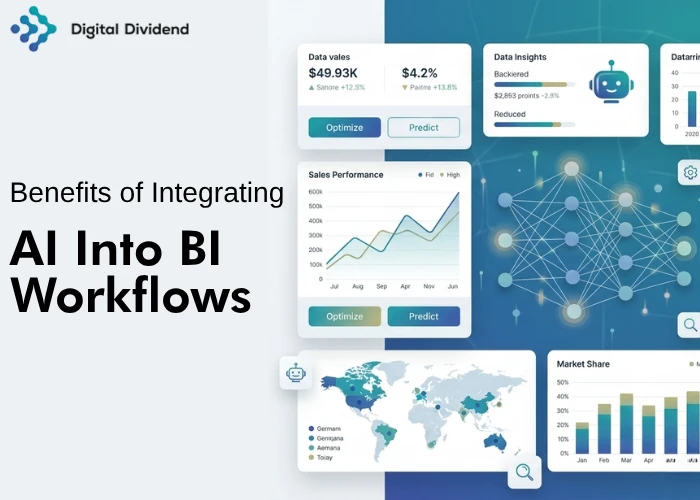
AI is turning business intelligence from a way to report data into a way to make decisions faster. The 2025 global survey by McKinsey found that 78% of businesses use AI in at least one area of their business, up from 72% in early 2024. This shows how quickly AI is becoming a part of analytics, operations, sales, and service workflows.
The market shift is just as clear. Grand View Research estimates the global business intelligence software market at $40.13 billion in 2025, reflecting strong demand for tools that improve speed, forecasting, and real-time visibility.
What AI integration means for BI workflows
AI integration adds machine learning, natural language processing, automation, and recommendation logic to the core BI stack. Instead of only showing past performance, BI systems can now surface patterns, predict outcomes, and support faster action.
In practice, AI fits across data preparation, analysis, reporting, forecasting, and monitoring. That matters for startups, healthcare businesses, SMBs, and enterprises because teams need answers faster than traditional reporting cycles can provide.
For companies building custom analytics systems, Digital Dividend works as a software development company and software service providers partner that can connect dashboards, data pipelines, web platforms, SaaS products, and mobile apps into one practical BI workflow.
How AI improves BI workflows
AI improves BI in four ways:
- Faster processing: It reduces the manual work involved in data cleanup, report creation, and pattern review.
- Smarter reporting: It helps generate summaries, highlight anomalies, and guide users toward the right metrics.
- Better decisions: It supports real-time insight, which improves response speed across operations, sales, and customer experience.
- Greater scale: It helps more users access useful analysis without requiring the same growth in analyst time.
Compared to traditional BI alone, AI-powered BI performs better because it shortens the path from raw data to action. That is where Digital Dividend brings expert developers and experienced developers with AI to build systems that scale without adding the same reporting burden.
Need faster reporting, smarter dashboards, and scalable analytics?
Digital Dividend is a software development agency with professional developer teams that build AI-ready BI systems around real business workflows.
What types of AI are used in BI workflows
The most common AI layers in BI include:
- Machine learning for forecasting, classification, segmentation, and trend detection.
- Natural language processing for plain-language querying and text analysis.
- Automation tools for repetitive reporting, data transformation, and workflow execution.
- Anomaly detection for spotting unusual values, fraud signals, and KPI shifts.
- Recommendation logic for suggesting likely next actions based on patterns in the data.
This mix matters because BI no longer depends only on static charts. It now supports guided analysis, predictive planning, and broader access across technical and non-technical teams.
Key benefits of AI in BI workflows
Better forecasting
Machine learning improves forecasting because it learns from past business data and adjusts as new data arrives. That helps teams plan revenue, demand, capacity, churn, and operational changes with less guesswork.
Easier analysis for non-technical users
Natural language features make BI more accessible because users can ask questions in plain language instead of relying on dashboards built only by analysts. As a result, more teams can use data without waiting in line for support.
Faster reporting
AI-assisted reporting reduces the time spent building pages, summaries, and presentations. That improves stakeholder communication because leaders can review findings faster and act sooner.
Clearer data visualization
AI improves visualization by helping users spot patterns, anomalies, and relevant comparisons more quickly. That makes dashboards more useful because users spend less time searching and more time deciding.
Stronger segmentation and prediction
AI helps classify users, detect behavior shifts, and predict likely outcomes from customer or operational data. That is especially useful for healthcare businesses, SaaS products, and enterprise teams that need action-ready insight.
AI applications in business intelligence analytics
Common BI use cases now include:
- Sales and revenue forecasting for pipeline planning and budget control.
- Customer behavior analysis for segmentation, churn risk, and retention planning.
- Operational performance monitoring for throughput, service levels, and internal efficiency.
- Risk and fraud analysis for anomaly detection and suspicious activity monitoring.
- Supply chain analysis for inventory, demand shifts, and delivery planning.
These use cases create more value when they are tied to custom systems instead of disconnected reports. Digital Dividend supports that work as software service providers and a software development company for teams building custom dashboards, internal tools, SaaS products, and analytics-driven platforms.
If your team needs custom dashboards, forecasting tools, or integrated analytics workflows, Digital Dividend can help as a software development agency with expert developers and experienced developers with AI.
How to measure the benefits of AI in BI
The best way to measure AI in BI is to track workflow improvement and business impact at the same time. Microsoft’s AI impact guidance highlights reporting speed and forecast accuracy as core measurement areas, while Salesforce’s 2025 data and analytics research found that 91% of business leaders believe AI makes it more important to be data-driven.
| Metric Area | What to Measure | Why it Matters |
|---|---|---|
| Reporting speed | Report build time, refresh cycles, analyst hours saved | Shows workflow efficiency |
| Forecast quality | Forecast error, variance from actuals, churn accuracy | Shows planning improvement |
| Business impact | Revenue growth, conversion rate, service response time, margin | Connects BI to outcomes |
| Adoption | Active usage, repeat AI feature use, lower analyst dependency | Shows whether teams use it |
A strong BI measurement model should show that outputs are faster, forecasts are better, and decisions lead to stronger operational or revenue results. That is usually where a professional developer team from Digital Dividend adds value by connecting analytics to the systems where teams already work.
Risks and limitations of AI in BI workflows
AI in BI creates real value, but it also comes with real constraints.
- Bias in models and outputs: Weak or skewed training data can distort forecasts and recommendations.
- Poor-quality input data: IBM notes that poor data quality costs organizations an average of USD 12.9 million each year.
- Governance and privacy concerns: Sensitive business and customer data require stronger policy controls and oversight.
- Integration and cost pressure: AI projects can stall when business value is unclear or when implementation complexity is too high. Gartner says that by the end of 2027, more than 40% of agentic AI projects will be canceled because they are too expensive, don’t have clear value, or don’t have strong risk controls.
- Interpretability issues: Some models are harder to explain, which reduces trust in high-stakes BI decisions.
- Over-automation risk: Teams still need human review because BI affects pricing, staffing, operations, and customer outcomes.
That is why AI works best as an enhancement, not a full replacement for governed BI. Dashboards, stable metrics, and shared reporting logic still matter because they create trust and consistency.
Trends shaping the future of BI with AI
Several trends are pushing BI forward:
- Self-service analytics is growing because teams want faster access to answers without waiting on analysts.
- Conversational BI is rising because users expect to ask questions in natural language.
- Predictive and prescriptive dashboards are becoming more common because companies want planning support, not just reporting.
- Embedded analytics is expanding because businesses want insights inside the software they already use.
- Agent-assisted decision support is gaining momentum. Gartner says that by 2027, 50% of business decisions will be augmented or automated by AI agents for decision intelligence.
For companies modernizing BI, the next step is not more reporting. It is better integration between data, products, and operational workflows. Digital Dividend helps businesses make that shift through software service providers’ support, expert developers, and experienced developers with AI who can turn analytics into usable systems.
Frequently Asked Questions
How AI enhances business intelligence workflows
It improves speed, automation, forecasting, and pattern detection, helping teams move from manual reporting to faster decision support.
How AI tools enhance BI reporting
They reduce report creation time, generate summaries, support natural-language analysis, and make outputs easier for stakeholders to review and act on.
Are there risks associated with AI in BI?
Yes. The main concerns include biased outputs, weak data quality, privacy issues, governance gaps, and over-reliance on automated recommendations.
Can AI replace traditional BI methods?
No. It works best as an added layer because dashboards, governed metrics, and consistent reporting still matter for trust and control.
How do you measure the benefits of AI in BI?
Track time saved, forecast accuracy, KPI improvement, and user adoption to see whether AI is creating real workflow and business value.
Conclusion
AI is making BI more useful because it adds speed, automation, forecasting, and stronger decision support to everyday analytics workflows. The shift is already visible in adoption data, BI market growth, and the move toward decision intelligence across modern analytics platforms.
For startups, healthcare businesses, SMBs, and enterprises, the strongest results come from connecting AI-powered BI to the systems teams already use. Digital Dividend supports that as a software development company, software development agency, and software service providers partner with professional developer teams and experienced developers with AI.
Ready to modernize BI without adding more manual work?
Talk to Digital Dividend for expert developers who can design, build, and scale AI-powered reporting, analytics, and decision systems.

Leave A Comment